Saturday, April 23, 2011

Kay Lenz's Performance in The Initiation of Sarah

The Initiation of Sarah (1978) is my favorite horror TV movie from the 1970s -- a decade famous as a Golden Age of horror TV movies. It's a Carrie ripoff, but as occasionally happens, it's better than the original.

As with Carrie, The Initiation of Sarah is about a nerdy girl with psychic powers (Sarah, portrayed by actress Kay Lenz) who is bullied by female classmates. This time it's college, rather than high school, but it's essentially the same story.

Because The Initiation of Sarah is a TV movie (and shot in the more innocent 1970s), it has less gore than Carrie. This means that Sarah must rely on other strengths. Without taking anything away from Carrie's Sissy Spacek, Sarah's greatest asset, among many, is Kay Lenz's performance as the nerdy Sarah.

Lenz's physical appearance, body language, mannerisms, and expressions consistently capture the nuanced timidity of a girl nerd. Consider Sarah maneuvering silently amid the ANS partygoers. (See below clip.) In her dowdy cardigan sweater, the 5'1" Lenz holds herself together, trying to avoid touching anyone as she squeezes past the exuberant taller girls chattering over her. The insecure Sarah strains to be inconspicuous, painfully self-conscious despite the beautiful ANS (Alpha Nu Sigma) girls' obliviousness to her.


It's a short scene, but The Initiation of Sarah is full of such moments when Lenz shines as Sarah. Unfortunately, the above clip seems out of sync, but focus on the visuals and you'll see what I mean.

The one flaw in Lenz's portrayal is when the ANS girls fling mud and vegetables at Sarah, who stands screaming rather than retreat into the house. Most likely, this was Robert Day's direction. A small mistake, in an overall fine job as director. (No, I don't buy that Sarah was "too shocked" to move; I rarely buy that horror's legions of screaming women are too shocked to move whenever a monster lumbers toward them.)

Carrie was remade starring the admirable Angela Bettis, one of the few current actresses who could equal, if not excel, Spacek's performance. I think of Bettis as a female Anthony Perkins; her character in May has a Norman Bates quality. Creepy, yet vulnerable and sympathetic.

It's possible that The Initiation of Sarah was likewise remade, though its DVD description indicates that the producers merely reused the title for an entirely different story. I've not seen this "remake," because most horror remakes of the past 15 years (unlike the ripoffs) have been dreadful, so I can't say for sure.

=======================

For more about the staging and performances of actors in horror, see Horror Film Aesthetics: Creating the Visual Language of Fear. This blog represents a continuing discussion of my views on horror, picking up from where the book left off.


Sunday, March 27, 2011

In Body of Work Realistic Acting Enhances Supernatural Horror

Like any art form, acting encompasses many styles. Certain styles are more aesthetically supportive of a film's story, characters, and themes than are other styles.

Acting can be theatrical and melodramatic (Who's Afraid of Virginia Wolfe, House of Yes), slightly theatrical and "stylized" (Bram Stoker's Dracula), hyper-stylized to the point of parody (Streets of Fire), hammy (Children Shouldn't Play with Dead Things, Blood Feast), deadpan (The Unbelievable Truth), scenery-chewing (William Shatner or Grayson Hall), or have the adults behave like children (Freaky Farley).

(No, I don't know every acting style out there; I'm sure many have yet to be discovered or invented.)

Filmmaker Alex Bram (Body of Work) believes that realistic acting is especially beneficial for supernatural horror. Bram says: "I am devoted to realistic acting, although I work in a surreal genre. So often, the unrealistic and cartoon style acting seems to creep into these kinds of movies."

Here's a trailer for Bram's supernatural horror short film, Body of Work:


Realistic performances help ground the Unnatural in reality, making the unreal seem real to audiences.

Critics have noted that one of Kolchak: The Night Stalker's strengths was that the show's supernatural monsters were offset by the cynical journalist, Carl Kolchak. If such a well-grounded character believed in the show's supernatural story elements, the viewer would more easily suspend disbelief.

The X-Files similarly set the Unnatural in a realistic milieu, with FBI Special Agent Dana Scully serving as the show's cynic. (Of course, since Kolchak had no partner, he was both Scully and Mulder, his character arc beginning the series as Scully, then growing over time into the more open-minded Mulder).

Realistic acting isn't always the best choice for a horror film, but it's a style that filmmakers might consider if the film's Unnatural Threat is especially incredible.

=======================

For more about acting styles and Unnatural Threats, see Horror Film Aesthetics: Creating the Visual Language of Fear. This blog represents a continuing discussion of my views on horror, picking up from where the book left off.
Saturday, February 26, 2011

Editing: An Unnerving Shot Sequence in Galaxy of Terror

This shot sequence from Galaxy of Terror twice misleads the audience by raising -- and then denying -- their expectations, unnerving them for the final shock.

The setting is inside a spaceship on a hostile planet. Ranger (Robert Englund) has just seen Captain Trantor (Grace Zabriskie) on a video monitor, apparently injured near an air lock. He rushes out of the room, toward the air lock.

We begin with this objective shot of Ranger running through a corridor:


We cut to a subjective shot of his POV rushing through the corridor:


Cut back to an objective shot of Ranger:


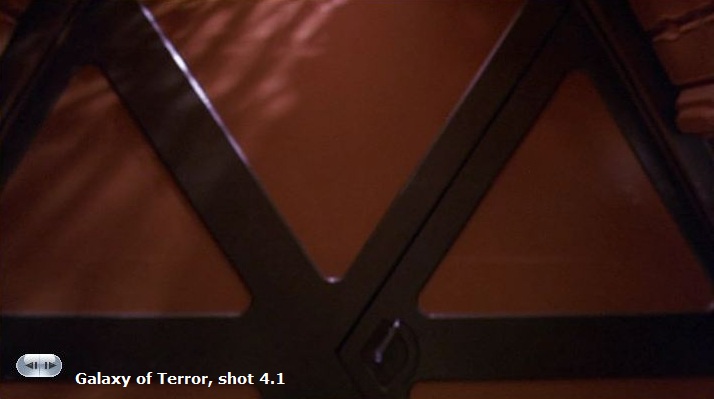
Cut back to a subjective shot of his POV, rushing toward this door:


But then the door opens -- and out comes Ranger!

We were fooled! Shot 4, unlike Shot 2, was not subjective! Not Ranger's POV.

By misleading viewers, director Bruce D. Clark has unnerved the audience, fraying its nerves for potential future shocks.


Cut to what looks like Ranger's moving POV:


And once again, the subsequent shots alternate between what appear to be subjective and objective shots.


Ranger approaches yet another door.

This appears to be his POV moving toward the door:


Will we be fooled yet again? When the door opens, will Ranger enter or exit from the doorway?


Neither!

The door opens -- and out comes the burnt body of Captain Trantor!


The previous misdirection in Shots 3/4 lowered our expectations for anything gruesome exiting from the second doorway, making Trantor's appearance all the more shocking.

===================

For more about how horror uses editing, and the difference between shocks vs. frights, see Horror Film Aesthetics: Creating the Visual Language of Fear. This blog represents a continuing discussion of my views on horror, picking up from where the book left off.

Also read my post on how editing misleads audiences in Vacancy.

Friday, February 25, 2011

What Is An Unnatural Threat -- And Why Does It Matter?

Horror requires an Unnatural Threat. Slasher films without an Uberpsycho (an indestructible, superhuman slasher, such as are Myers or Jason) lie closer to suspense/crime thrillers than to horror. Weak, pathetic slashers (e.g., Maniac, Don't Go in the House) are Natural Threats, hence, only tenuously horror.

Why does it matter? What differentiates a Natural Threat from an Unnatural Threat?

The quality of fear.

Compare these scenarios:

1. You're at home, alone with a loved one. Just the two of you. Someone you've known and loved and trusted for many years. Say, a husband. You're talking intimately. Suddenly, he pulls a gun on you, snarling, saying he's hated and lied to you all these years, and now he will kill you.

Horror? No, the threat is natural. Happens every day. It's shocking and frightening, but the tale could as easily make for a crime thriller, a suspense film, or a soap opera.

2. You're at home, alone with a loved one. Just the two of you. Someone you've known and loved and trusted for many years. Say, a wife. You're talking intimately. Your wife enters the bathroom, leaving the door ajar. You see her reflected in the mirror, though she doesn't realize that you see her. As she calls out to you, cheerful and loving, she reaches under her chin and peels off her face, revealing a hideous alien. A bizarre hole in her "face" continues shouting to you, in her lovely voice, cheerful and friendly. Her eye-thing glances into the mirror and sees you watching her...

That's horror. That's an Unnatural Threat. The quality of fear differs. The Ring and The X-Files inspire a qualitatively different fear from the fear evoked by Saving Private Ryan, Death Wish, or Underworld.

An Unnatural Threat evokes both fear and a sense of wonder. An Unnatural Threat is awesome and mesmerizing. This is why an Unnatural Threat packs a stronger emotional punch than does a Natural Threat.

Some films do qualify as horror, despite their Natural Threats. I'm talking about the Naturalistic Psycho Gorefest, whose killers are colorful and bizarre (not weak or pathetic), as is found in Texas Chainsaw Massacre or House of a 1000 Corpses).

But because the quality of fear differs from unnatural psychos, I'm inclined to think that the Naturalistic Psycho Gorefest is not a horror subgenre, but an entirely different horror genre.

=======================

For more about Unnatural Threats, Uberpsychos, Apparent Uberpsychos, and Naturalistic Psycho Gorefests, see Horror Film Aesthetics: Creating the Visual Language of Fear. This blog represents a continuing discussion of my views on horror, picking up from where the book left off.

Thursday, February 24, 2011

Masks Empower Horror Psychos and Slashers

The classic horror psycho is what I call an uberpsycho. A dark, enigmatic, force of nature. Indestructible and relentless, he feels no pain, no empathy, no sympathy. He doesn't run, but plods forward, calmly confident in his ability to catch his victims, and fearing no pursuer.

Halloween's (1978) Michael Myers was the first uberpsycho -- and the first horror psycho. Until Myers, psychos primarily inhabited mysteries, suspense films, crime thrillers, etc.

Psycho (1960) is an excellent and frightening film, but Norman Bates is a suspense psycho. He is mortal and vulnerable. He is a natural threat, and thus elicits from audiences a different quality of fear than a unnatural threat.

An uberpsycho is an unnatural threat. Myers and Jason are indestructible and superhuman, for no good reason. Our sense of their indestructibility is supported by their enigmatic nature. Try to explain their strength, and they become less mysterious. Hence, they become less believable -- and less powerful, less threatening.

To create this enigmatic aura around a horror psycho, it's helpful to keep them hidden either offscreen or behind a mask. A psycho risks being disempowered (i.e., feel less threatening) when we see his face.

Final Exam and He Knows You're Alone both feature silent, nearly mute psychos, killing for no apparent reason. Yes, they're skillful with a knife. Final Exam's killer even has the required superhuman strength.

Yet because we see their faces early on, they're brought down to our human level. They are less impressive. Not enigmatic, dark forces of nature, but merely crazy humans on a killing spree. These films edge away from horror, toward the suspense/crime thriller genres.

Alfred Hitchcock famously said that a strong villain makes for a strong film. Alas, the psychos in Final Exam and He Knows You're Alone are nondescript rather than enigmatic.

Even worse is when a film focuses on a mundane psycho (rather than on the victims), showing us his pathetic life in detail (e.g., Maniac, Don't Go in the House). In such films, the psycho appears weak, vulnerable, and natural. We feel disgust and pity, rather than awe and fear.

To shoot an effective horror slasher film (rather then a suspense or crime thriller), it helps to hide your psycho offscreen or behind a mask.

Apart from uberpsychos (an unnatural threat), there is another sort of horror psycho found in naturalistic psycho gorefests. These psychos are mortal (i.e., naturalistic), but they're also colorfully crazy and fearless (e.g., Texas Chainsaw Massacre, House of a 1000 Corpses), rather than pathetic or nondescript.

But they're another issue, not to be found on the "slasher spectrum," which runs from the enigmatic (Halloween) to the nondescript (Final Exam) to the pathetic (Don't Go in the House).

=======================

For more about Unnatural Threats, Uberpsychos, Apparent Uberpsychos, and Naturalistic Psycho Gorefests, see Horror Film Aesthetics: Creating the Visual Language of Fear. This blog represents a continuing discussion of my views on horror, picking up from where the book left off.

Wednesday, February 23, 2011

It's Film, Cinema, or Motion Picture -- But Never Say "Movie"

Last December, while reviewing Horror Film Aesthetics, a critic for Zombos' Closet wrote: "Ever notice how calling a movie a film makes it sound much more important and academic? I suppose it helps when discussing horror movies--I mean films--especially their visual language."

I assume "Zombos" was half-joking -- yet his observation is closer to the truth than he probably realizes.

In my first class at NYU's film school, a professor told us that the correct way to refer to a film was "film, cinema, or motion picture." All three were acceptable. But we were admonished to never say "movie." Only the ignorant called it "a movie."

The students eagerly lapped it up. Jargon helps separate "professionals" from "amateurs," implying expertise in a difficult subject. Film students need this psychological boost. Many "lay people" suspect that studying film is not as intellectually taxing as, say, calculus or quantum physics. (Okay, it isn't).

Jargon not only suggests to outsiders that the speaker is entitled to respect; jargon also helps convince the speaker that his years of study aren't wasted.

Apart from jargon, film students sometimes imply their expertise by expressing certain preferences. Black & white is preferable to color. Grainy images are preferred to high-resolution. Film is better than video. Foreign or obscure films are superior to American or popular films. (Which is not to say that these same film students wouldn't like to work for Hollywood.)

Some students waver on some points, but those were the generally approved preferences at NYU film school when I attended. It made for some comical conversations. One student would say that he preferred black & white to color, whereupon another insisted, "Oh, I love black & white!" and then another would jump in to insist on her even greater love for black & white.

Then someone would add, "I especially love grainy black & white," and someone would jump in to say, "Oh, I love grain!" And so on.

I view film snobbery with 90% disdain, 10% admiration. A pinch of film snobbery is fun, and can spice up a film review or book.

How much snobbery is too much? A review should be intelligent, but accessible. A person of average intelligence, without any training, should be able to easily understand what you're saying, and the points you're making.

There no excuse for inscrutable prose. Alas, many academic film books use jargon that's so obscure, you can't find the words in a dictionary. No, I'm not exagerating. My film texts at NYU were full of words I didn't know, and couldn't find in a dictionary.

Film is not a difficult subject. It only requires average intelligence to master cinematic concepts -- provided the professor isn't writing in intentionally obscure, academic code.

If a film book is incomprehensible, then the author is either a poor writer, or is trying to hide a paucity of ideas under a mountain of verbiage.


=======================

For what I hope are intelligent, yet accessible, insights on horror films (with just a pinch of snobbery), see Horror Film Aesthetics: Creating the Visual Language of Fear. This blog represents a continuing discussion of my views on horror, picking up from where the book left off.
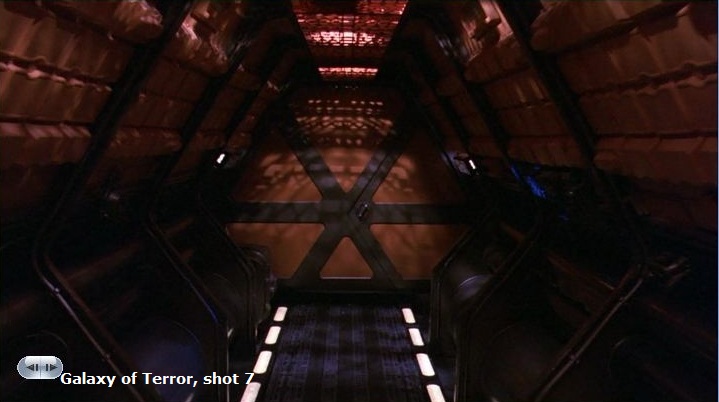
Image in this post is that of Michael Myers as Dieter Dieter.

Friday, February 18, 2011

Mad Scientists: "Gender" Determines Their Mise-en-Scène

If one knows a mad scientist's sex, one can pretty much predict his or her fashion sense, hair style, and demeanor. This horror icon's mise-en-scène is as rigidly sex-specific as "blue is for boys" and "pink is for girls."

Yes, there are exceptions. But for the most part, gentleman mad scientists favor rumpled clothing, unkempt hair and megalomaniacal outbursts. They can never contain their enthusiasms when their big experiments come to fruition.

Consider Drs. Frankenstein, Pretorius (Bride of Frankenstein, 1935), and Rotwang (Metropolis, German 1927).

Even the often uptight Herbert West laughs like an hysterical lunatic on occasion.

By contrast, lady doctors are always uptight. Always neat. They rarely display any emotion about their Great Work, or anything else for that matter. Their lips are as tight as their hair buns.

Consider Dark Shadows's Dr. Julia Hoffman; Dr. Parkinson (Fiona Lewis) in Strange Behavior (Australian 1981); and Dr. Carter (Kate Trotter) in the "And Now the News" episode of TV's Friday the 13th: The Series.

Yes, there are exceptions. The normally cool Julia Hoffman loses it on occasion, and when she does so, actress Grayson Hall equals Willian Shatner in her scenery chewing.

Why this male/female divide in mad scientist style and behavior?

Is our society frightened by undisciplined, wild men, unable to control themselves, or contain their lusts, passions, greed, and ambitions? Whereas crazy, irrational behavior is "normal" coming from "the weaker sex," whose destructive potential isn't all that great anyway.

By contrast, a cold, emotionless woman is "unnatural." Heartless and cruel. There's no telling what bizarre crimes against nature she may commit. But a cold, emotionless man is trustworthy. Self-control makes him safe and reliable. Silent and strong.

I've never been much for "gender studies" (I think "sex" is more accurate than "gender" when applied to people), and I don't know if these are the reasons for how male vs. female mad scientists are portrayed.

Furthermore, while male mad scientists tend to be unkempt and ranting, and female mad scientists are cold-blooded and uptight, this male/female divide does not appear so much among other villain icons.

For instance, Bond villains (mostly men) tend to be cold, emotionless, and hyper-rational, whereas suspense thrillers have their share of hyper-hysterical female villains (Fatal Attraction).

It's mostly among mad scientists where evil men and women have switched their traditional emotional roles.

=======================

For more about the use of mise-en-scène in horror films, see Horror Film Aesthetics: Creating the Visual Language of Fear. This blog represents a continuing discussion of my views on horror, picking up from where the book left off.