Saturday, March 7, 2026

Dark Shadows: Recasting Dr. Woodard Lessens Audience Sympathy for His Death

I’ve written previously about the importance of actors in creating a character. One example of how recasting an actor can change our feelings about the other characters in the show is the recasting of Dr. Dave Woodard in TV’s Dark Shadows.

The character of Dr. Woodard was introduced in April 1967. Richard Woods portrayed Dr. Woodard for the character’s first two episodes, but Woods was quickly replaced by Robert Gerringer, who made Dr. Woodard his own. Gerringer filled the character with his persona, creating a Dr. Woodard that was intelligent, compassionate, empathetic to his patients, and sympathetic to viewers.

Robert Gerringer as Dr. Dave Woodard

Five months later, Gerringer was replaced by Peter Turgeon. Turgeon’s persona differed markedly from that of Gerringer. Whereas Gerringer was a broad fellow with a gruff voice and full head of hair, Turgeon was thinner, with a higher pitched voice, thinning hair, and eyeglasses. Gerringer appeared strong and solid. Trugeon appeared geeky and prone to hysteria. That his eyes were difficult to see behind his eyeglasses made it that much harder for audiences to emotionally connect with him, to build rapport and empathy.

Peter Turgeon as Dr. Dave Woodard
 

This would have significant ramifications when, less than two weeks later, Barnabas Collins and Dr. Julia Hoffman murder Dr. Woodard. Had they murdered Gerringer’s Woodard, viewers would have felt greater outrage and anger at Barnabas and Julia. But instead, though viewers knew Woodard had been murdered, they didn’t feel it. Turgeon’s geeky Woodard still felt like a stranger to them; he wasn’t the Woodard they had come to know and love.

Barnabas was still scripted as a villain, but he was becoming more beloved by audiences. Had he murdered Gerringer’s Woodard, the audience’s growing sympathy for Barnabas might have slowed, and perhaps never attained the degree it eventually reached.

This was not the reason Dr. Woodard was recast shortly before he was murdered. NABET was on strike and Gerringer refused to cross the picket line to tape Dark Shadows at the ABC network studio. Yet this was the result of the recasting.

I regret the recasting of Dr. Woodard. I think the murder of Gerringer’s Woodard would have made for an emotionally more powerful episode.

=================

For more about creating an effective horror story on film or video, see Horror Film Aesthetics: Creating the Visual Language of Fear. This blog represents a continuing discussion of my views on horror, picking up from where the book left off.


Sunday, January 4, 2026

Wintery Horror vs. Summer Horror

I am asked, "How does summer horror differ from winter horror in lighting and color?"

I don't think there's a consistently or reliably different aesthetic effect between a wintry vs. summer mise-en-scène. And to the extent there is, I wouldn't focus on lighting or color.

I love wintry horror films, but that's largely a personal taste. I love winter, period. I find gray skies and barren streets emotionally uplifting. Bright, sunny skies depress me. Maybe I have a reverse form of seasonal affective disorder. Perhaps many goths do too. (Although, I am not a goth; I live in khaki.)

Either a winter or a summer setting can support a horror film's story, characters, or themes. The bleak, wintry scenes in Ghost Story support the characters: four old men, in the winter of their lives, their situation frozen, unchanging, by an old, guilty secret. Their elder lives contrast with the flashbacks to their youth, set in summer, when a guiltless future was still before them.

Yes, many people associate winter with bleakness and despair. Filmmakers can exploit this. The stark Canadian winter scenes in The Brood reflect Frank's bleak situation, his marriage "gone cold."


The wintry scenes in The Changling reflect John's depressing situation, having recently lost his wife and daughter in an auto accident.

But bright, sunny summer scenes can also reinforce a film's horror. If not by reflecting the character's bleak situation, then through contrast.

The Final Terror and The Prey (and many summer camp slasher films) are full of sunny outdoors footage -- creating a bright mood which contrasts with the brutal slayings. The Prey's sunny outdoor footage itself embodies contrasts; its footage depicts wildlife prey. Nature is brutal, despite the summer sun -- as is that psycho who grew up in the natural wilds, soon to prey on the campers!

Winter and summer mise-en-scène can both help or hinder a horror film, depending on how is relates to the film's story, characters, or themes. It all depends on context.

=========================

For more about my thinking on mise-en-scène in horror, see Horror Film Aesthetics: Creating the Visual Language of Fear. This blog represents a continuing discussion of my views on horror, picking up from where the book left off.

Tuesday, August 5, 2025

Miscasting Adam Hann-Byrd in Halloween H20

It's been said that "90% of directing is casting."

Every actor has a specific persona. A certain "look," presence, and degree of charisma. Not every actor is right for every role. An actor's talent and training can sometimes overcome his being miscast, and sometimes even create a more interesting film because of it. But more often not.

Cast the right actor and he'll fit right into the film's story with little work on the director's part. Miscast an actor, and you're squeezing a square peg into a round hole. Not only will the director have a harder time making the film "work," but audiences will have a harder time suspending their disbelief. Poor casting can make audiences roll their eyes.

My eyes roll every time I see Charlie (Adam Hann-Byrd) and Sarah (Jodi Lyn O'Keefe) in Halloween H20. As sex-crazed teenage lovers, they are woefully mismatched.

Sarah is a tall woman with classic, fashion model looks. Charlie is a short geeky guy. The IMDB says that O'Keefe is 5'9" and that Hann-Byrd is 5'10" but I don't believe it. On screen she is often taller than him.


Additionally, the IMDB states that O'Keefe was born in 1978, Hann-Byrd in 1982. Halloween H20 was released in 1998, but films are often shot the year before release. Assuming their IMDB listed birthdays are accurate, the statuesque O'Keefe was 19 or 20 during the shoot, whereas the diminutive Hann-Byrd was 15 or 16.

(The characters are supposed to be 17, so kudos for not casting thirtysomething actors to play teenagers.)


What makes this miscasting so glaring, at least for me, is that Sarah is written as always lusting for Charlie's body. At one point, Charlie pulls Sarah down (he can't actually lift her) and exclaims, "We can have a roving orgy!"

Sarah responds, "I love the way this man thinks!"

That scene is just cringe.

Especially now that I know the taller O'Keefe was an adult, whereas Hann-Byrd was still a minor, when I hear her calling him "this man" ... cringe.

Their scenes together are few and brief (about three), but in all of them, Sarah openly lusts for Charlie (and he for her). That's how the scenes are written. But the casting doesn't support it. The casting induces eye rolls. Suspension of disbelief is strained.

Yes, tall beautiful woman do date and marry short, even unattractive men. But usually those men have money, fame or status. That's not the case in Halloween H20. Charlie isn't even a particularly nice guy. He shoplifts alcohol. He lies. He steals food.

Hann-Byrd might be a great guy and a talented actor. But he's simply miscast in this film.

Night of the Demons (2009) displays similarly incongruent casting. A beautiful woman dates a dorky drug dealer. But that drug dealer, as written, has a more "fleshed out" personality. His character is flawed, yet engaging and sympathetic. It's less of a stretch to think that a beautiful woman might be interested in him.

By contrast, Charlie, as written, is one-dimensional; he is an unscrupulous horn dog. Nothing more. All he has to offer Sarah is his physical body. In which case, the producers should have cast a body that would believably appeal to a one-dimensional campus beauty.

==================== 

For more information on working with actors, see Horror Film Aesthetics: Creating the Visual Language of Fear. This blog represents a continuing discussion of my views on horror, picking up from where the book left off.

Tuesday, July 15, 2025

Rise of the Random Horror Anthology Film

Historically, horror anthology films were written by the same writer and helmed by the same director. The wraparound and individual tales were all linked -- dramatically, thematically and aesthetically. This was true of the first such film, Dead of Night (1945). It was true of Amicus's anthology cycle (1965-74) and of Creepshow (1982).

Spirits of the Dead (1968) and Two Evil Eyes (1990) are rare examples where the shorts had different directors, but they were specifically produced with the final feature in mind. All the stories were dramatically and thematically linked; in both films, all shorts were inspired by Edgar Allan Poe.

Fast forward to the 2000s. The proliferation of horror film festivals, YouTube, and cheaper and easier digital filmmaking equipment, led to a massive increase in the production of short horror films. At which point, distributors come up with an idea. Why spend money shooting an entire feature film, when you can just buy up some shorts, shoot a wraparound for them, and call it a feature?

And thus was born the random horror anthology film, which has become so prevalent as to practically be its own subgenre.

Unlike the Amicus films, I'm not sure a random horror anthology film even qualifies as a "feature" film. If a producer cobbles together a bunch of disparate shorts, which have already played at film festivals, and often even on YouTube, then shoots an unrelated wraparound for them, is that a feature?

All Hallows' Eve 2 (2015) was so sloppily constructed that some of its shorts are foreign films with subtitles. That lack of aesthetic unity is emotionally jarring, reminding us that this is not a coherent feature but merely a collection of shorts. It hinders our suspension of disbelief. The wraparound itself is merely a woman watching these shorts on TV. We don't need this wraparound; we're already doing that by watching this film.

All Hallows' Eve 2 is the sequel to the far superior All Hallows Eve (2013), which introduced Art the Clown. Art only appears briefly in All Hallows' Eve 2's wraparound, not in any of the shorts. I'm guessing the producers wanted to cash in on the success of All Hallows' Eve, but quickly and on the cheap. Maybe they weren't sure, at the time, that Art had staying power or was worth the investment.

Obviously, they changed their minds, hence, Terrifier (2016) and its sequels.

Even so, All Hallows Eve 2 is dreadful. So too the Red Book Ritual series (more random shorts with a disconnected wraparound). And many other random horror anthology films too numerous to mention.

=======================

For more information on subgenres and aesthetics, see Horror Film Aesthetics: Creating the Visual Language of Fear. This blog represents a continuing discussion of my views on horror, picking up from where the book left off.


Thursday, April 24, 2025

House of Death (aka Death Screams) Badly Butchered in "Restored" Streaming Versions

House of Death (1982, aka Death Screams) is an obscure slasher films from the 1980s, and thus many people might not notice if a distributor butchers it. But I own eight different copies of the film: a Beta cassette, a DVD, and six MP4 files.

That House of Death has never enjoyed a digital restoration released on blu-ray is not entirely logical, because many horror films that are both worse and more obscure have been released on blu-ray.

I was initially pleased to see the film's version on Tubi, because its visual quality is improved in some ways. Colors are more vibrant, and images are sharper than most (but not all) versions found YouTube, which seem to be transfers from old video cassettes (VHS, I assume). In terms of color and resolution, the Tubi version is superior even to my DVD version (which also seems taken from an old video cassette).

But the problems with the Tubi version are twofold. (I call it the Tubi version, but I've found an identical version on YouTube, so I doubt that Tubi is responsible for the film's "restoration".)

First, the Tubi version employs what I call "double cropping." This is when a distributor takes a widescreen film whose sides have been cropped to create a full screen (for old TV sets), then crops this full screen's top and bottom to create a new widescreen.

Thus, a widescreen film has been cropped twice, leaving little of the original image. Enough to be watchable, but the director's original compositions are gone. Wide shots become medium shots, medium shots become closeups, closeups become extreme closeups.

Observe the two below images from House of Death. The top image is a video cassette's full screen image (the original widescreen already cropped at the sides.) The second image (taken from Tubi) has cropped the image for a second time, this time its top and bottom, to create a new widescreen. The film's original widescreen has now been cropped on all four sides.


You'll notice the Tubi version's improved colors and resolution. I assume the restoration was done on a version found on an old video cassette. The original widescreen version (probably 35mm film stock) is probably lost.

But that's no excuse for the double cropping. If only a full screen version remains, let's watch House of Death in full screen. Cropping additional material to create a new widescreen only makes things worse.

I suppose distributors think the public wants widescreen and won't realize they're watching a badly butchered version rather than the original image.

But Tubi's version of House of Death has additional problems. It's missing two key sequences.

IMDB lists House of Death with a running time of 1.28 (an hour and 28 minutes). Tubi's version runs at 1.28.06. My MP4 versions range from 1.25.30 to 1.31.33. Clearly, House of Death has suffered many distributors and re-edits.

Here are the sequences missing in Tubi's version, which appear on my Beta tape and the 1.31.33 MP4 version on YouTube:

1. The scene wherein Romana sneaks into the coach's house is longer (and includes a topless shot of actress Jennifer Chase). That this scene is excised from the 1.28 versions is obvious from the crudely abrupt cut from the bathroom to the bedroom, the characters' whole demeanors having changed. Something had obviously occurred between them, but what? In the longer version, we see that the coach rebuffed Romona's advances, and tossed her into the shower to "cool off."

2. In the penultimate scene, when the coach attacks Lily with a machete, there is a brief flashback that depicts the coach as a young boy in the bordello in which his mother worked. This flashback explains why he hates and kills "slutty" women (and their men). This flashback is missing entirely from the shorter 1.28 versions.

In the final scene (in both long and short versions) Sandy asks "Why?" She and everyone else is baffled as to why the coach went on a murder spree. Viewers of the shorter version are equally baffled. But those of us lucky to have seen the longer version, know the answer.

==================

For more information on composition and editing in horror films, see Horror Film Aesthetics: Creating the Visual Language of Fear. This blog represents a continuing discussion of my views on horror, picking up from where the book left off.

Sunday, March 16, 2025

Can We Please Lose the Overhead Drone Shot?

It's become a cliché. The overhead drone shot of a car driving along a highway or through a forest. Despite some minor variations, I've seen these shots way too often. They're pointless apart from looking pretty, because they're rarely aesthetically motivated. As an establishing shot, they have become banal and, well, cliché.


As a cliché, the drone shot of the driving car rivals the fruit cart. As described in Roger Ebert's The Little Book of Hollywood Clichés, whenever a film has a chase scene, and you cut to a fruit cart, you just know a speeding vehicle will collide with that cart.

Why are filmmakers so in love with overhead drone shots? I have a theory.

Camera drones are a relatively recent consumer technology. Prior to them, overhead shots required expensive cranes or helicopters, operated by highly paid (often unionized) workers. Thus, overhead shots were both rare and impressive. In the 1980s, SCTV even had a running gag about TV personality Johnny LaRue (John Candy) incessantly badgering the station owner for a crane with which to wow his audience. Crane shots were big league.

And so when drones became available to ordinary folk, filmmakers jumped at the chance to showcase their new toy. They used and overused drones, much like filmmakers of the late 1960s/early 1970s overused their newly affordable zoom lenses.

Because they used to be expensive, filmmakers think that an overhead shot will make their films look slick and professional and expensive.

In Horror Film Aesthetics, I observed that in They (2002), the camera looks directly down upon (rather than from an angle at) city buildings. Aesthetically, seeing building roofs and city streets passing below us creates (1) an emotionally unsettling geometric pattern, because an ordinary city suddenly looked "alien" to us, and (2) creates a sense of some evil looming overhead.


But in 2002, such shots were fresh, rare, and therefore emotionally jarring. But as with Japanese ghosts crawling along the floor with their faces obscured, the emotional impact of overhead drone shots have lost their punch as audiences become jaded through repeated exposure.

I also love the moving overhead shot of bridges to New Jersey in Lost Souls. In the context of the story, with the brooding clouds and sun breaking over the skyline (I wonder how much color correction was done in post?), the cinematography creates a sense of impending Apocalypse.

And again, because of its expense, that kind of shot was rarely seen. (Lost Souls was released in 2000, but shot in 1997, so I'm assuming the shot was created with a helicopter.)

At this point, overhead drone shots are so commonplace, they no longer impress. Audience know that drone shots aren't expensive. Plus, so many crappy low-budget films open with overhead drone shots, I groan when I see them, expecting the worst. Another poor filmmaker who hopes to hide his poor story and actors with technical wizardry.

One "cool shot" cannot compensate for a poor story, mediocre acting, and sloppy production values in the overall film. Actually, it can have the opposite effect. If the film is mostly bad, then one great element (a beautiful shot, a classic song, a single fine actor) can create a contrast, highlighting how awful is the rest of the film.

When computer video editing software became widespread some 20 years ago. I'd watch low-budget, independent horror films with amazing opening credits that raised my hopes and expectations. And then followed a really bad film, like something a group of amateurs had shot with a camcorder.

Amazing opening credits only makes a bad film look worse. The same can be said of drone shots.

Drone shots, like all technical aspects in a film, should be aesthetically motivated. Which means they should support the film's story, characters, or themes.

And sometimes the old ways are best. An establishing shot doesn't have to be from the sky. Unless there's some point to an overhead shot, a ground level shot will do just a nicely. Focus on telling a good story with a talented cast; not on wowing us with your new toy.

==================

For more information on framing and cinematography in horror films, see Horror Film Aesthetics: Creating the Visual Language of Fear. This blog represents a continuing discussion of my views on horror, picking up from where the book left off.

Monday, February 3, 2025

Do Young Fans Ignore Old Horror Films?

Horror filmdom has suffered a rash of remakes these past few decades. It's one of the more disheartening trends in modern horror.

What was the point of the Omen remake? It mimicked the original, scene for scene, but without Jerry Goldsmith's creepily demonic music soundtrack. Nearly identical, minus some of the better parts.

The Haunting remake was no better despite offering a new story. The remake removed all the ghostly atmosphere and subtle characterizations of the original, replacing them with embarrassingly silly and inappropriate CGI effects. I suppose Hollywood thought that “modern” means CGI.

Dozens of other examples come to mind. But the big question: What's the point of all these remakes?

John Carpenter offers a theory. In the Special Features documentary on The Fog remake's DVD (another inferior remake), Carpenter says:

“I've heard several reasons why horror films are being remade. One, I think, probably is the simplest explanation, is a lot of kids have heard of these movies, but they've never really seen them. Maybe they've heard their older brothers or their parents talk about them. So it's in their consciousness, but they've never paid attention.

“But in general there's a cultural mindset right now that says anything over fifteen years old is kind of dead and old-fashioned. And so in order to make it viable again, we need to take it out, and kind of give it a fresh coat of paint, and try to revise the corpse.”


So Hollywood thinks that young horror fans have heard of these old films and are interested in seeing them, but refuse to do so because the films are over 15 years old.

Huh?

Does anyone say, “Wow, that film sounds great. I'd like to see it. But it's old, and so I can't.”

Not only illogical, but contrary to the evidence.

Horror is the most enduring of genres. The 1930s Dracula and Frankenstein films remain widely known and admired nearly a century later. Even lesser known horror films from that period (e.g., The Black Cat, The Raven, Maniac, The Devil Bat) win new fans each year. Despite some exceptions (e.g., Gone with the Wind, Stagecoach) the same cannot be said for dramas or westerns from the 1930s.

Horror is evergreen. Hardcore horror fans love horror films from every decade. There's no need to remake the older films (even if Hollywood does, on rare occasion, do it well, as in 1978's Invasion of the Body Snatchers).

So why does Hollywood produce so many remakes? Three theories come to mind.

1. Famous older films are seen as a pre-sold commodity, hence, a “sure thing.”

2. Hollywood has run out of new ideas.

3. Young horror fans refuse to watch any horror films made before the 2000s.

Of those three theories, I doubt there's much truth to #3. Young casual film goers might shun older horror films -- but not young hardcore horror film fans.

Ironically, the hardcore horror film fan is the core target market for these horror remakes. Why? Because only they would know about, or care about, all the horror films that have been remade over the past 15 years.

The Toolbox Murders Thirteen Ghosts, The House on Haunted Hill -- all remade (even when they only kept the title). Not the sort of films known to casual film goers, but films that continue to attract hardcore horror fans of every age.

I believe that hardcore horror film fans of every age, being connoisseurs, appreciate horror films of every era. No need for all the bad remakes. Try to come up with something original (e.g., It Follows).

==============

To learn about the four attractions of horror films, see Horror Film Aesthetics: Creating the Visual Language of Fear. This blog represents a continuing discussion of my views on horror, picking up from where the book left off.


Monday, January 6, 2025

Beneath: A Cave Horror and Its Brief Glimpses in the Dark

Beneath: A Cave Horror (2018) accomplishes much with little. Its story is unoriginal and its cast is unpolished, yet the film has a creepy atmosphere and genuine scares.

The story consists of five young tour guides who work for a local cave attraction. The cave is infamous as the site where a cult conducted a human sacrifice to conjure a demon -- the Midnight Man -- back in 1966. And so, on Halloween night of "The Present Day" (as the screen credits inform us), the tour guides conceive the bright idea of holding a party in the cave along with a ceremony to conjure the Midnight Man.

No, they don't intend a human sacrifice. Just a little blood drawn from each guide's finger. Perhaps a human sacrifice is unnecessary because the Midnight Man presumably already lives in the cave, but, as the internet informs them, he slumbers after every ten years if he's not called. So this is a lesser ceremony meant to wake him. (Okay, the rationales are kinda murky.)

Beneath runs at about 78 minutes (not including end credits), and our heroes enter the cave a half hour into the film. So most of this low budget affair is set in the cave.

The cave provides a dark, creepy, claustrophobic atmosphere. Some areas are well lit, but I suppose a tourist attraction would have a light setup. At some point, the guides wander off the designated tour path, and it gets darker.

Like many low-budget horror films, Beneath demonstrates that nature does not discriminate against the poor. A cave (or forest, or desert, or beach) looks equally impressive whatever the budget.

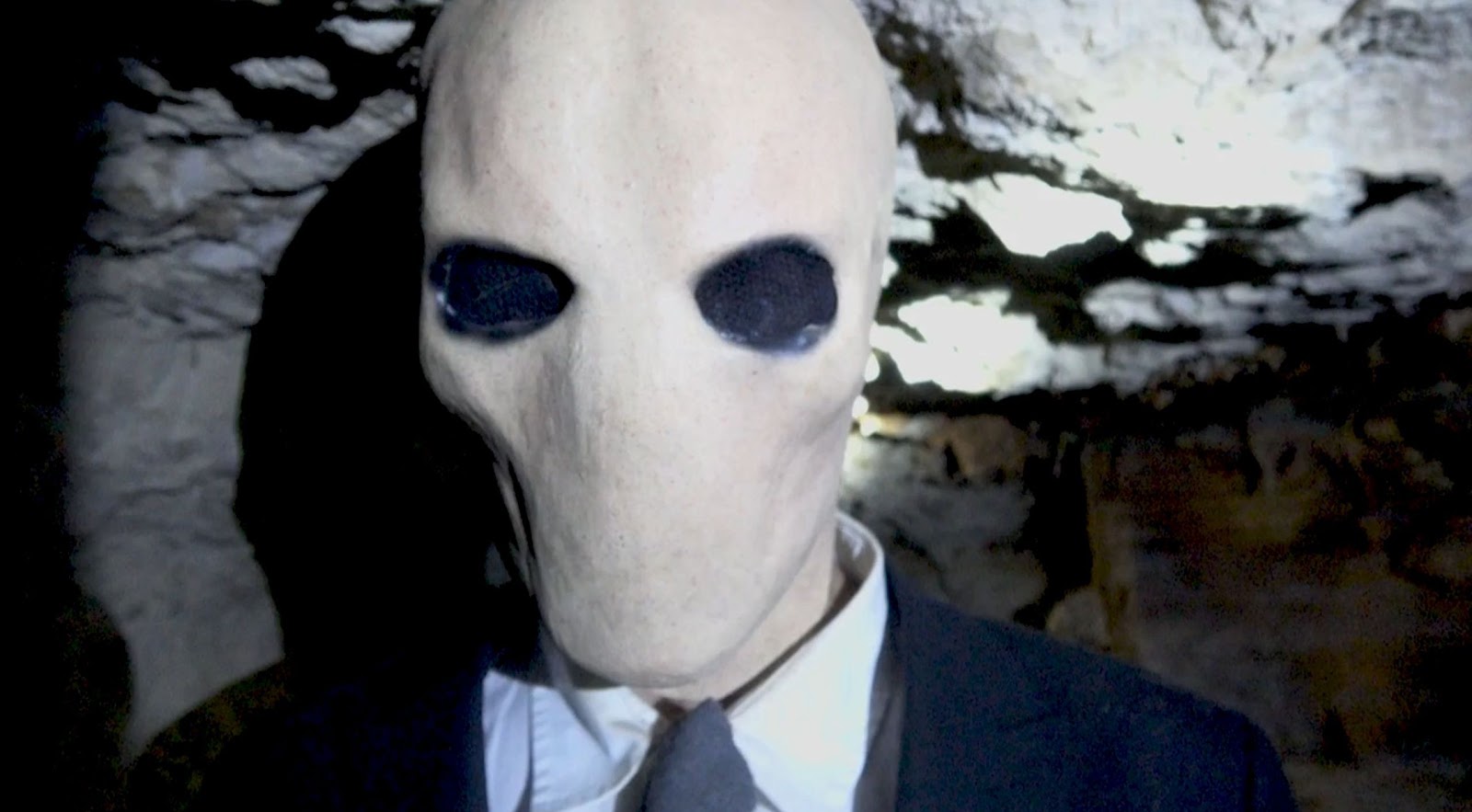
But I especially admire Beneath's handling of the demonic Midnight Man. I'm not a big fan of Full Moon's rubber suit demons. By contrast, the Midnight Man is just a man in a black suit wearing a gray alien mask (well, a beige alien). The face is original and unexpected (not your usual demon) and thus startling at first glance.

Filmmaker J.J. Perez doesn't spend much screen time showing us his demon. Only brief glimpses in the dark, usually in wide or medium shots. This is wise because lingering on the face, especially in close-up, would lessen the tension. The face would more obviously appear as a silly mask.

If you have an obvious mask, or crude make-up, best limit its appearance to brief glimpses. Plus there's the theory that if an audience doesn't clearly see something, their imaginations will fill in the unseen details with the worst assumptions.

This technique of showing only brief glimpses of the horrific can also be seen in Tower of Evil (British, 1972) the "Mannikins of Horror" (sic) episode of Monsters (1989), and The Crane Wife (2024).

Perez uses another old trick to good effect, one that combines lighting and editing:

Sarah (Meghan Forbes) is alone in the cave when her flashlight runs out of power. So she uses her camera's flash as a light, repeatedly taking photos, seeing what's up ahead with each flash. For the first two flashes, she sees nothing. The next four flashes shows the Midnight Man approaching. Sarah grows ever more panicked. (Why doesn't she run?) But the next two flashes shows no demon.

Is Sarah safe?

Horror fans know that, though the demon appears to have left, the next time Sarah flashes her camera, the demon will be right in front of her. And sure enough, that's what happens.


It's an old trick, but it works. It's one of the most effective scares in Beneath.

Beneath: A Cave Horror, has a low score on IMDB. Yes, the film is rough in spots. The cast's delivery of the unoriginal dialog is stilted at times. Even so, Perez displays talent. I enjoy Beneath for what it is: well made trash horror with much entertainment value.

=========================

For more information on lighting or editing in horror films, see Horror Film Aesthetics: Creating the Visual Language of Fear. This blog represents a continuing discussion of my views on horror, picking up from where the book left off.


Sunday, January 14, 2024

David J. Skal, R.I.P.


Several horror icons whom I admire have died these past several months. I just now learned that David J. Skal (1952 - 2024) died after being hit by a drunk driver in Los Angeles.

I first encountered Skal through his book, The Monster Show. A self-described "cultural history of horror," his book is informative, filled with original insights, and well written; a breezy, entertaining read, mercifully free of academic jargon. The prose is literate yet accessible to lay readers, the way film criticism should be always.

I later read his Death Makes a Holiday: A Cultural History of Halloween, as part of my research for a class I taught at The Learning Annex about Halloween haunted houses. It was great preparation for my lecture.

I only met Skal once, in the fall of 2001, at Burbank's Dark Delicacies horror bookstore. Several writers were there for a book-signing, including me and Skal. I had brought The Monster Show for him to sign, which he did. I still prize that book with his inscription.

To my surprise, he bought a copy of my book, Halloween Candy and asked me to sign it. I took it as his way of encouraging a fellow writer and fan who was hardly in his league.

Overall, Skal was a fine historian, a skilled writer, and a gracious man.


Monday, March 1, 2021

Stagefright Uses Editing to Disorient and Unnerve

The editing in Michael Soavi's Stagefright (1987) effectively disorients the audience, thus unnerving them and making them more susceptible to shocks and fear.


A mad slasher (wearing an owl mask) is stalking six people trapped in a theater. Alicia (Barbara Cupisti) runs into the shower room, where she finds Laurel (Mary Sellers) lying in the left stall, bloodied but still alive. Alicia hears the slasher approaching from the hallway.


Cut to the slasher in the hallway.


Cut to Alicia, having heard the slasher, closing back the curtain on Laurel in the left stall, then hiding in right stall.


Cut to Alicia in the right stall, pulling the curtain closed.


Cut to the slasher entering the shower room. Two curtained stalls before him. Laurel on left (behind the bloodied curtain). Alicia on the right.


Cut to Alicia in the stall.


Cut to the slasher's POV (point of view), coming toward the two shower stalls.


Cut to the slasher's silhouette across the curtain. He is drawing near.


Cut to Alicia's worried expression. Her eye line is directed at the curtain. Her acting and the eye line match implies that the silhouette is her POV. That the slasher is approaching her stall.


Cut to Alicia backing against the wall. Her staging reinforces the notion that the silhouette is against her curtain.


Cut to slasher drawing nearer to the curtain. Close enough that his owl mask is visible. Then in the same shot, he yanks aside the curtain.


Cut to a close up on Alicia. Her eye line is directed toward the slasher in the previous shot. She appears to be looking at him.


Cut to the slasher drawing nearer. The mask's eye line directed at Alicia in the previous shot.


Cut to Alicia's POV of the slasher looming over Laurel. In the same shot, he raises Laurel, who looks toward Alicia in the right stall.


Cut to Alicia looking back at Laural, eye line match to Laurel.

Thus Stagefright's editing has fooled us. The POV shots, eye line matches, acting, staging, and editing suggested that the slasher was approaching Alicia's stall. But it was Laurel's. He still doesn't know that Alicia is there. She is still safe.

For more examples of how editing can disorient an audience, see my posts on Vacancy and Galaxy of Terror.

===============

For more information on editing in horror films, see Horror Film Aesthetics: Creating the Visual Language of Fear. This blog represents a continuing discussion of my views on horror, picking up from where the book left off.

Thursday, February 25, 2021

Inconsistent Dialog in Death's Door (2015)

As I've discussed in recent posts, bad writers often have characters spout clichés and catchphrases that are inconsistent with their previous statements or behavior, because it's an easy way to fill up pages with dialog. Even good writers fall into this trap, because clichés and catchphrases come naturally to people. But good writers should delete these in subsequent rewrites. 

In Death's Door (2015), a group of young people trespass into a deceased magician's house for a night of partying. Naturally, the house traps them inside. Ghostly manifestations and grisly deaths ensue. The survivors search for clues as to what's happening, and how they might escape.


While some young folk search through boxes, perusing old scrapbooks of newspaper clippings, Suzanne (Danielle Lilley) says, "Maybe we shouldn't be doing this. This is all private stuff."

Huh? 

Suzanne trespassed into this house along with everyone else. The film had no scenes showing any hesitation on her part. Indeed, when we first meet Suzanne, it is she who is pressuring her more timid friend into coming along.

Thus it's out of character for Suzanne to now feel scruples about invading anyone's privacy. Nor do any previous scenes provide motivation for her to have "matured" morally. Indeed, the recent hauntings and killings in the house provide additional motivation in the opposite direction -- for Suzanne to search the boxes for clues to escape the house.

So why did Kennedy Goldsby write this line of dialog? Filler. Thoughtless filler. Goldsby has several of his nondescript characters in the bedroom, and he likely felt a need to give them each something to say. So he had Suzanne say, "Maybe we shouldn't be doing this. This is all private stuff." 

After all, it's what some people would say if they saw someone looking through someone else's private belongings.

Except that Suzanne is no longer just anyone. She has an inner life -- personality, emotions, habits, morals, motivations -- as established by the previous scenes. But Goldsby has forgotten his previous scenes. He seems to have focused solely on whatever scene he's currently writing. And he failed to notice Suzanne's inconsistency in subsequent rewrites.

Death's Door is a treasury of bad dialog: fillers, clichés, catchphrases, and inconsistencies. The characters are nondescript and interchangeable, lacking unique voices. Much of their dialog can be randomly redistributed among them, without changing the story. They shout and argue for no purpose other than to fill up time and try to create "suspense." But as their arguments lack proper motivation, their constant bickering is annoying rather than suspenseful or revealing.

Death's Door does have good make-up effects. It's an enjoyable film if you're in the right frame of mind; if you just want to see a random group of young people killed in gory fashion, and can do without a clever story or engaging characters.

For more examples of poorly motivated characters and inconsistent dialog, see my posts on The Dark, Lake Fear 3, Dark Floors, In Search of Lovecraft, Prometheus, and The Haunting of Marsten Manor.

===============

For more information on writing in horror films, see Horror Film Aesthetics: Creating the Visual Language of Fear. This blog represents a continuing discussion of my views on horror, picking up from where the book left off.

Tuesday, February 23, 2021

Setting Up Twists in Twists of Terror

Low-budget horror films often spring arbitrary surprises on viewers. The slashers' identities in House of Death (1982, aka Death Screams) and Girls Nite Out (1982), are arbitrary surprises because there was no dramatic setup; no clues pointed in their direction. Some viewers might have guessed, but only due to their familiarity with genre conventions (i.e., He was too obviously innocent, or, She couldn't be the killer so naturally she probably is).

Mysteries must play fair with readers and viewers by providing clues before revealing the killer. That's the purpose of the genre: to present a solvable puzzle. But horror's primary purpose is to scare, and a dearth of clues can make an unknown killer more frightening. If you can't guess his identity, he can be anyone.

Yet all storytelling requires some logic, even if only a kind of surreal "dream logic." (Dario Argento and David Lynch are masters of dream logic.) So while horror is more flexible on logic than some other genres, there is a breaking point. Too many arbitrary surprises, and audiences will roll their eyes, and have difficulty in suspending their disbelief. On the other hand, the more entertaining a film, the more forgiving audiences are about any flaws, including plots holes, stupid characters, and arbitrary twists.

The Canadian TV movie Twists of Terror (1997) is aptly titled. Each tale in this horror anthology has a "surprise twist." While the twists are unoriginal and sometimes excessive in number, they are mostly well set up, and the film is entertaining enough so we can forgive the strains in logic.


In "The People You Meet," a young couple, Joe (Carl Marotte) and Amy (Jennifer Rubin), celebrate their honeymoon over dinner. They express love for each other, though there are intimations that all was not always well. Later, they suffer a car accident at night. Rednecks kidnap them, tying up Joe in a shed. He urges Amy to escape, which she does.

After she darts out of the shed, Joe berates the rednecks. Surprise! 

Turns out Joe hired the rednecks to stage the accident, and rape and kill Amy so he could collect on the insurance. Joe hates Amy. The rednecks leave the shed to hunt down, rape, and kill Amy.

They return with Amy, unharmed, who then mocks Joe. Surprise! 

Turns out Amy knew that Joe hated her, as she hates him -- and she was having an affair with the very same redneck Joe hired, so she knew about Joe's plans. The redneck now kills Joe.

This is a bit much. Screenwriter John Shirley did drop some clues about problems in the marriage over dinner, so we can believe Joe plotting against Amy. But Amy's affair with the redneck feels arbitrary (a second twist for its own sake) and ridiculous. Still, because "The People You Meet" is entertaining and energetic, we can overlook the silly double twist.


In "The Clinic," Mr. Rosetti (Nick Mancuso) is bitten by a dog at night. He stumbles upon a hospital and enters for emergency care. But the doctor, the nurse, the ambiance are strange and creepy. In the end Rosetti discovers that he's in an insane asylum -- and the lunatics have taken over. Surprise! 

Again, not unexpected. Both the ambiance (similar to that in X-Ray, aka Hospital Massacre, 1981), and genre conventions, promise a dark surprise. Nor is the specific surprise all the surprising. We've seen this same "twist ending" in Asylum (1972) and Don't Look in the Basement (1973).

But the surprise was logically set up by the atmosphere created by creepily soothing doctor, the hyper-sexualized nurse, the deserted hallways and hints of gore. And the story was entertaining.


In "Stolen Moments," Cindy (Francoise Robertson) is a sexually and emotionally repressed woman seeking romance. She has difficulty connecting with men. She instead lavishes her affections on her many pets. Then she meets Barry (Andrew Jackson), a yuppie in a singles bar, and agrees to meet him at an empty house later that night. Is Cindy in danger?

She meet Barry. They have passionate sex. Cindy thinks it's love. Then Barry brings out his male buddy. Barry wants them to gang bang Cindy. Surprise! 

Turns out Barry is a creep. But then he speaks tenderly to Cindy. Maybe he's not so sleazy? Cindy agrees to a threesome to please Barry. But afterward, Barry is cold to Cindy, saying it's time to go home. Surprise! 

Barry really is sleaze. As Barry is getting dressed, he hears a scream. He finds his friend's freshly killed corpse. Cindy looks terrified. Barry thinks there might be a prower. Then Cindy knocks Barry out with a hammer. Surprise! 

Turns out Cindy is the killer. Has she snapped because they used her? But when she goes home, she has an entire bulletin board with tokens from her past victims. Surprise! 

Turns out Cindy is a serial killer. As a newspaper headline confirms the next day.

None of this is surprising to those familiar with genre conventions, so these surprises are not arbitrary. Both Cindy and Barry emitted warning signals. Cindy was repressed, neurotic, with too many pets. A classic 1990s, neo-noir femme fatale in the body of a prude. And Barry was too smooth talking, sensitive, and handsome. A stereotypical blond yuppie sleazeball pretending to be Mr. Perfect. From the start, I knew it was 50/50 that Cindy was the villain.

Once again, an entertaining story. 

===============

For more information on writing in horror films, see Horror Film Aesthetics: Creating the Visual Language of Fear. This blog represents a continuing discussion of my views on horror, picking up from where the book left off.


Wednesday, February 10, 2021

Inconsistent Dialog in The Dark

Bad writers often have a character spout clichés and catchphrases that are inconsistent with their personalities or previous statements, or pointless within the context of the story. Writers do this because clichés and catchphrases are an easy, thoughtless way to fill up a page. Such writers are too lazy or sloppy to write appropriate dialog, or to keep their story and characters in mind while writing. 

Even good writers can make this mistake, because clichés and catchphrases come naturally to people, writers included. But, while inappropriate clichés and catchphrases might infect a first draft screenplay, writers should be careful to delete them in subsequent rewrites.

The Dark (1979) is great fun, as I explain in my review. But for all its merits, it also provides an example of a character who contradicts herself with clichés and catchphrases. 

Zoe (Cathy Lee Crosby) is a TV reporter who covers fluff, but is eager to do hard news. She sees her potential big break when a serial killer (actually, a space alien) starts terrorizing Los Angeles.


In one scene, Zoe accuses Detective Mooney (Richard Jaeckel) of not doing enough to stop the killer. But moments later, when Mooney responds by talking tough, Zoe switches and accuses him of being too tough. "Thirty-two caliber justice?" she accuses.

So, is Zoe a tough-on-crime crusader? Or a bleeding heart liberal? She takes both sides in less than a minute. Why? Perhaps the writer wanted Zoe to sound strong and spunky, and thus was mindlessly filling Zoe's mouth with zingers, however inconsistent.

Of course, it's possible that Zoe is spouting inconsistent zingers because she's a disingenuous, yellow journalist who'll say anything to make a splash. In which case, that's her character. She is motivated not by any philosophy, but by her ambition. She'll say anything to embarrass Mooney, consistency be damned. In that case, the character is consistent (even if her lines are not) and the script is fine.

But that is not the case. Zoe is clearly a heroine we are meant to admire, so the scene is poorly written.

Zoe is supposed to be smart, but she's not very. She pontificates on TV that it's "ironic" that the daughter of horror novelist Roy Warner (William Devane), who writes gore, was killed in a gory fashion. Warner later accuses Zoe of implying that it was "poetic justice." Zoe insists that she meant ironic, but that's because she's illiterate. Irony requires incongruity, so it would have been ironic if Warner's books had promoted peace.

Zoe is supposed to be smart and idealistic, yet as written, she sounds illiterate and ego-driven.

I won't blame screenwriter Stanford Whitmore. After I wrote my initial review of The Dark, Whitmore emailed me [on August 13, 2004]:


"I wrote [The Dark] on spec as a piece that my friend, DP Bill Butler, would use to get his foot in the directing door. My script was an experiment meant to take advantage of Bill's camera, which would render the repeatedly gathering dark remindful of the score for Jaws. An initial deal was made with Dick Clark's company, and when that fell out, some thief stepped up to single-handedly take over the script, fire Tobe Hooper, and invent a monster shooting death rays. The upshot was the WGA bringing suit on my behalf for monies owed, whereupon said producer skipped town, putting a cherry on top."


For more examples of poorly motivated characters and inconsistent dialog, see my posts on Lake Fear 3, Dark Floors, In Search of Lovecraft, Prometheus, and The Haunting of Marsten Manor.

===============

For more information on writing in horror films, see Horror Film Aesthetics: Creating the Visual Language of Fear. This blog represents a continuing discussion of my views on horror, picking up from where the book left off.

Monday, February 8, 2021

Poorly Motivated Characters and Inconsistent Dialog in Lake Fear 3

Acting guru Konstantin Stanislavski taught that characters have inner lives that motivate their behavior at every point in a story. A character's actions should be consistent with his desires, goals, personality, and changing situation throughout a novel, play, or film. It's how an actor should approach a role. It's how a writer should write a character.

For every scene, the writer must ask, If I want this character to do X, how can I motivate the character to do X? If no believable motivation can be created, the character should not do X.

Some reasons for poorly motivated characters:

1. Writers treat characters like puppets on a string, serving the interests of the plot, even when the character's actions contradict their previously established inner lives. 

2. Writers fill a character's mouth with clichés and catchphrases, because the writer is too lazy, thoughtless, or untalented to construct sharp yet believable lines. 

Poorly written stories are full of characters who simply "decide" to do this or that. Slasher films are famous for characters who decide to go for a walk alone in the dark woods, after everyone else has mysteriously disappeared. The character might even have been afraid to go out 20 minutes earlier, when the writer wanted the character to stay indoors. But now that the writer wants the character to be killed, the character changes his mind and decides to go for a walk.

This is the puppet on a string, devoid of an inner life. Audiences, sensing that something is off about the character, that the character is ridiculous, have difficulty suspending their disbelief and empathizing with the character. Instead, they simply laugh when the puppet is killed onscreen.

Poorly motivated characters often spout self-contradictory dialog.


In Lake Fear 3 (a bad film on many levels), Revel (Shanon Snedden) is seeking her missing sister. Her friend Chloe (KateLynn E. Newberry) thinks it's a lost cause. So she hires TV psychic Vincent (Devi Khajishvili) to put Revel's mind to rest about her sister.

Chloe's request is itself an astonishingly poor piece of writing. She instructs the psychic, "She (Revel) needs closure. Just make something up for all I care. She needs this." 

Really? Just make something up? So Vincent can claim that Revel's sister is alive in Toronto, married to a millionaire, or that she was tortured to death in Chicago -- doesn't matter.

But writer Gerald Crum is determined to make his bad script worse. Sitting down with Revel and Chloe, Vincent asks about the sister, "So, ah, how did she go missing?" 

Chloe snarkily interjects, "Isn't that your job?" 

Meaning, Vincent is supposed to be psychic. He should know how the sister went missing.

But wait a minute. Chloe knows Vincent is a fraud. She hired Vincent to lie to Revel. Chloe's motivation is to give Revel closure. So why is Chloe undermining Revel's faith in Vincent's psychic abilities? Chloe paid good money for Vincent to lie, and now Chloe is sabotaging his ability to lie.

My guess is that writer Crum was focused on the scene, in making Chloe sexily snarky, and forgot about the previous scene. He was treating Chloe like a puppet, having her serve the current scene (here is where you "decide" to be sexily snarky), and he forget about Chloe's inner life and motivations as established in previous scenes.

Also, Crum might have thought that Chloe's putdown of Vincent's psychic abilities was a funny bit of dialog. Crum's focus was on the scene and the line, not on Chloe's character -- her inner life and motivations.

Lake Fear 3 is full of bad dialog, poor characterization, and awful acting. (The makeup effects are good.) An especially egregious example of bad dialog occurs after demons attack the trio and Revel is killed. Chloe and Vincent find themselves with Remington (Joshua Winch), who knows about demons. Crum thinks this is good time for his characters to engage in an argument.

Bad writers often have characters engage in poorly motivated arguments, because they think it's a good way to create tension, suspense, and drama. And during this pointless argument ...

Chloe snaps at Vincent, "Like you're one to talk. You're just a fraud." 

Vincent replies, "Oh my God. That's called being an actor." 

Chloe says, "Okay, yeah. Well, if you would have told me and my friend that you were just an actor, we'd be hundreds of miles away by now. But no. You needed your fifty dollars." 

Huh? Chloe knew Vincent was a fraud. She hired him to "Just make something up." She even admits to paying him $50. So why is she in the same breath saying "if you would have told me and friend you were just actor, we'd be hundreds of miles away by now."

Apparently, writer Crum isn't paying attention to anything he'd previously wrote. His focus is always on his current scene, ignoring whatever came before. And he's filling up every scene with whatever lines sound snarky, cool, funny, or dramatic -- to hell with the context of the story, or consistency of character.

Viewers who are still paying attention at this point are rolling their eyes.

For more examples of poorly motivated characters, see my posts on Dark Floors, In Search of Lovecraft, Prometheus, and The Haunting of Marsten Manor.

===============

For more information on writing in horror films, see Horror Film Aesthetics: Creating the Visual Language of Fear. This blog represents a continuing discussion of my views on horror, picking up from where the book left off.