Showing posts with label lighting. Show all posts

Monday, January 6, 2025

Beneath: A Cave Horror and Its Brief Glimpses in the Dark

Beneath: A Cave Horror (2018) accomplishes much with little. Its story is unoriginal and its cast is unpolished, yet the film has a creepy atmosphere and genuine scares.

The story consists of five young tour guides who work for a local cave attraction. The cave is infamous as the site where a cult conducted a human sacrifice to conjure a demon -- the Midnight Man -- back in 1966. And so, on Halloween night of "The Present Day" (as the screen credits inform us), the tour guides conceive the bright idea of holding a party in the cave along with a ceremony to conjure the Midnight Man.

No, they don't intend a human sacrifice. Just a little blood drawn from each guide's finger. Perhaps a human sacrifice is unnecessary because the Midnight Man presumably already lives in the cave, but, as the internet informs them, he slumbers after every ten years if he's not called. So this is a lesser ceremony meant to wake him. (Okay, the rationales are kinda murky.)

Beneath runs at about 78 minutes (not including end credits), and our heroes enter the cave a half hour into the film. So most of this low budget affair is set in the cave.

The cave provides a dark, creepy, claustrophobic atmosphere. Some areas are well lit, but I suppose a tourist attraction would have a light setup. At some point, the guides wander off the designated tour path, and it gets darker.

Like many low-budget horror films, Beneath demonstrates that nature does not discriminate against the poor. A cave (or forest, or desert, or beach) looks equally impressive whatever the budget.

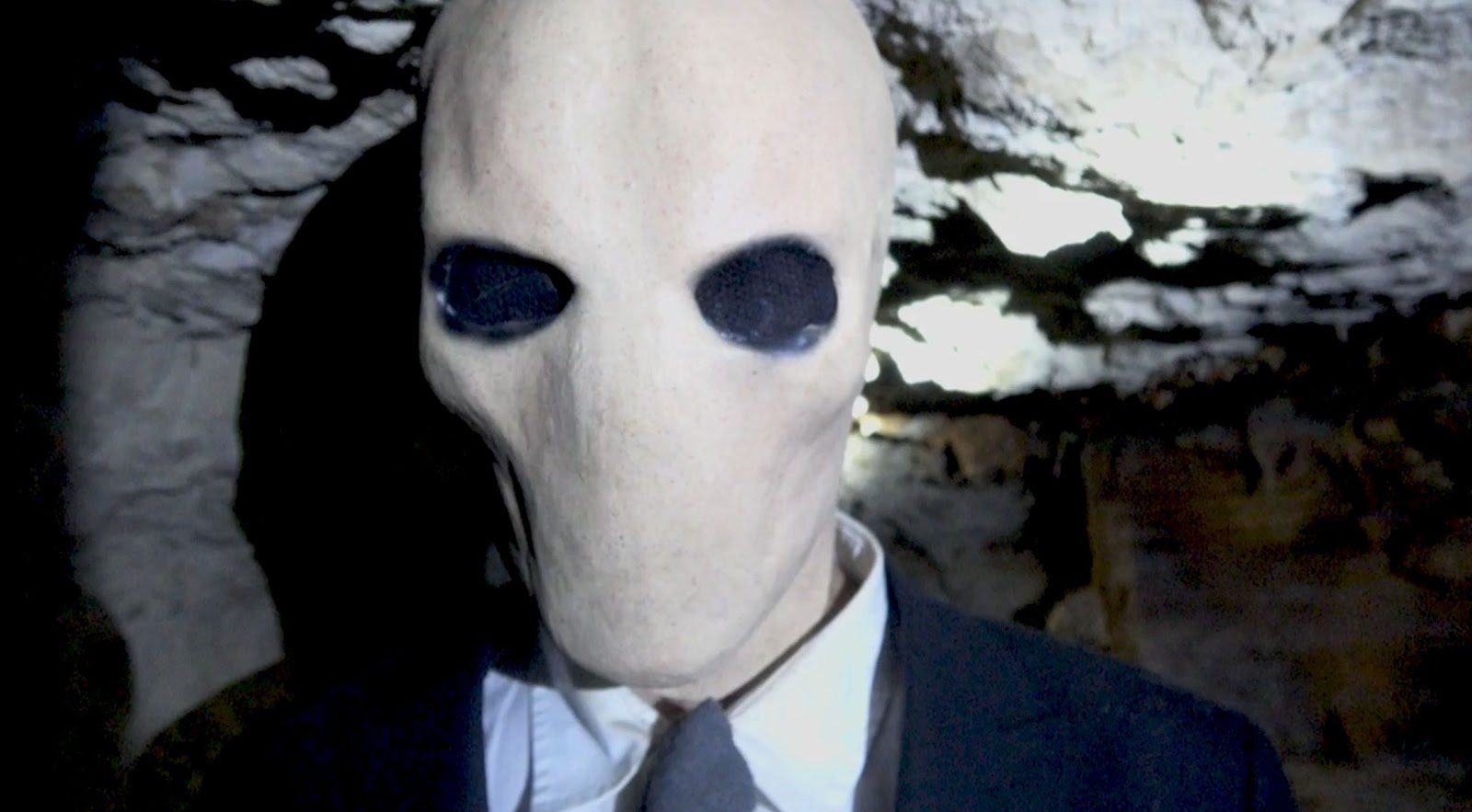
But I especially admire Beneath's handling of the demonic Midnight Man. I'm not a big fan of Full Moon's rubber suit demons. By contrast, the Midnight Man is just a man in a black suit wearing a gray alien mask (well, a beige alien). The face is original and unexpected (not your usual demon) and thus startling at first glance.

Filmmaker J.J. Perez doesn't spend much screen time showing us his demon. Only brief glimpses in the dark, usually in wide or medium shots. This is wise because lingering on the face, especially in close-up, would lessen the tension. The face would more obviously appear as a silly mask.

If you have an obvious mask, or crude make-up, best limit its appearance to brief glimpses. Plus there's the theory that if an audience doesn't clearly see something, their imaginations will fill in the unseen details with the worst assumptions.

This technique of showing only brief glimpses of the horrific can also be seen in Tower of Evil (British, 1972) the "Mannikins of Horror" (sic) episode of Monsters (1989), and The Crane Wife (2024).

Perez uses another old trick to good effect, one that combines lighting and editing:

Sarah (Meghan Forbes) is alone in the cave when her flashlight runs out of power. So she uses her camera's flash as a light, repeatedly taking photos, seeing what's up ahead with each flash. For the first two flashes, she sees nothing. The next four flashes shows the Midnight Man approaching. Sarah grows ever more panicked. (Why doesn't she run?) But the next two flashes shows no demon.

Is Sarah safe?

Horror fans know that, though the demon appears to have left, the next time Sarah flashes her camera, the demon will be right in front of her. And sure enough, that's what happens.


It's an old trick, but it works. It's one of the most effective scares in Beneath.

Beneath: A Cave Horror, has a low score on IMDB. Yes, the film is rough in spots. The cast's delivery of the unoriginal dialog is stilted at times. Even so, Perez displays talent. I enjoy Beneath for what it is: well made trash horror with much entertainment value.

=========================

For more information on lighting or editing in horror films, see Horror Film Aesthetics: Creating the Visual Language of Fear. This blog represents a continuing discussion of my views on horror, picking up from where the book left off.


Sunday, April 5, 2020

Creative Lighting in Boris Karloff's Thriller

An admirably creative use of lighting appears in a 1961 episode of Boris Karloff's Thriller, "God Grante That She Lye Stille."

Margaret (Sarah Marshall) is a young woman possessed by a witch's ghost. In the end, the witch is defeated and expelled from Margaret's body. Margaret then lies exhausted in bed, attended to by Edward (Ronald Howard), a doctor who has fallen in love with Margaret.

Margaret and Edward speak. Edward helps Margaret sit up in bed. They hug and make plans for their future. Then Margaret is set back down in bed, whereupon she dies.

Observe the lighting in this scene. Margaret is initially brightly lit. But when she is set back down on bed, she is placed into darkness.


There is no logical reason within the story for this sudden darkness. All the presumed light sources in the bedroom should still be functioning. This change in lighting nondiegetic in that it doesn't originate from within the story.

Aesthetically, the change in lighting is symbolic and emotional. A subtle way of symbolizing the life leaving Margaret, while also conveying the emotional pain felt by Edward (and hopefully by us, the audience).

This change in lighting is subtle, because I doubt that many viewers consciously noticed it. It more likely affected them solely on an unconscious, emotional level. I myself wasn't sure the lighting had changed when I first saw this episode. Rather, I did a double take, thought it might have changed but wasn't sure, then replayed the scene. Of course, this would have been impossible in 1961 when the episode first aired.

The cinematographer was Benjamin H. Kline. Directed by Herschel Daugherty.

=============

For more information on lighting for horror, see Horror Film Aesthetics: Creating the Visual Language of Fear. This blog represents a continuing discussion of my views on horror, picking up from where the book left off.

Wednesday, October 10, 2018

Off Duty Uses Creative Lighting to Depict the Supernatural Realm

In Off Duty, Police Constable Layton (Becki Pantling) investigates a haunting in a warehouse. It's something she performs "off duty," perhaps because the higher ups would frown upon her psychic gifts. She can commune with ghosts.

Off Duty is a spooky little ghost story, creepy and atmospheric. A British horror short which successfully captures that X-Files vibe. A police procedural with a serious tone and unexpected, original twists. PC Layton isn't just a ghost hunter. She's a vigilante.

The lighting is especially impressive. DP Jamie MacLeod uses two distinct lighting setups. One for the normal world and one for the astral realm that Layton enters. Warm yellow lights for normalcy. Cold blue lights for the astral plain.


The concept is similar to the lighting schemes used in Insidious and Stranger Things (to depict "The Further" and the "Upside Down," respectively), but simpler and on a much lower budget. Thankfully, Pantling and MacLead avoid the use of green nightvision. Ghost hunter films should give that a rest.

===========

For more about lighting in horror films, see Horror Film Aesthetics: Creating the Visual Language of Fear. This blog represents a continuing discussion of my views on horror, picking up from where the book left off.

Sunday, June 17, 2018

Contrasting the Visuals in Two MOS Horror Films: Daughter of Horror and The Beast of Yucca Flats

Daughter of Horror (aka Dementia, 1955) and The Beast of Yucca Flats (1961) were made within a decade of each other. Both films are low budget affairs. Both "feature" runs at under an hour. Both were shot in black & white. Both were shot MOS (i.e., without any sound recorded on set). What sound there is was dubbed in afterwards.

Despite their similarities, they are markedly different. Daughter of Horror is an admirable work of art. The Beast of Yucca Flats is schlock This is why it's instructive to study these films together. Especially their handling of MOS. What did the first film do right that the second got wrong?

You won't find many MOS films these days. Modern video cameras have built in sound recorders. Not so film cameras in the 1950s. And so, some low budget filmmakers tried to save money by doing without sound recorders and boom mics on set, instead shooting MOS and dubbing in the sound during post production.


Comparing these two films, you'll see that Daughter of Horror embraces its MOS limitations. The film has no dialog. Instead, it relies on powerful visuals. Director John Parker's compositions are beautiful and arresting, borrowing stylistically from German expressionism. His harsh lighting creates extreme, angular shadows, and rich, deep blacks.

The production design and staging are similarly expressionistic. For one scene, Parker found an impressively gargantuan staircase. In another, the woman enters a nightclub and is creepily and claustrophobically surrounded by what initially appear to be floating arms.  

Parker's visual style creates a surreal sensibility, which is appropriate as we are allegedly sharing a mad woman's nightmares and/or hallucinations. (She wakes up, but remains uncertain if it was only a dream, so it could be either.)


By contrast, The Beast of Yucca Flats tries to hide its MOS limitations. The film does its (poor) best to fool the audience into thinking that sound was recorded on set. There is dialog. But because it was dubbed during post-production, director Coleman Francis uses several tricks to conceal that the dialog doesn't sync with his actors' lips. When the actors talk, they're always seen from a distance, or obscured in darkness, or behind an object. Or talking off screen -- whereas filmmakers normally show the actor who's speaking, Francis instead frames the actor who's listening, the talker being out of camera frame.

Francis's technique cheapens his film. An actor's voice carries much of his personality. Because we never see his actors speak the voices we hear, some emotional connection with the audience is lost. Better for them never to have spoken in the first place.

Unlike Parker, Francis doesn't provide interesting visuals. His images are dull. Mostly people wandering the desert. Still worse, he shot his film day-for-night (i.e., during the daytime, with the film underexposed to create a nighttime look). Day-for-night is often used for wide expanses (e.g., desert vistas) because of the expense of lighting such large areas. Had Francis rented some generators and lights, he might have had the rich blacks and sharp shadows of Daughter of Horror. Instead, The Beast of Yucca Flats suffers from flat "lighting." Dull, grayish, washed-out.

Apart from dialog, The Beast of Yucca Flats dubs many other diegetic sounds: wind, gunshots, screams, and engine noise (from cars and planes). The only diegetic sound dubbed in Daughter of Horror is laughter. Thus does the latter further embrace its MOS limitations.


Both films have music and narration. Daughter of Horror's narration is more self-aware and self-referential. The narrator addresses the protagonist. "Run, daughter of horror, run." By contrast, Yucca Flats's narrator addresses the audience. The former dynamically interacts with its surreal world. The latter fills in the narrative gaps created by the MOS limitations, telling us (rather than showing) what we would otherwise have learned through the missing dialog.

Narrative gaps are a problem for The Beast of Yucca Flats, because the film attempts to tell a traditional horror/sci-fi story about a killer monster. By contrast, Daughter of Horror doesn't have a linear story, but is a subjective, surreal look at madness. 

Daughter of Horror was initially released as Dementia and had no narration. (The top YouTube clip is without narration, the latter with.) Some fans believe the narration harms the film. Even so, Daughter of Horror's narration better serves its film than the narration for The Beast of Yucca Flats. The latter's narration aims for a philosophical profundity that comes off as unintentionally funny. 

Daughter of Horror should be studied for tips on how to tell a tale visually. Good to know even if you're making a sound film. As for The Beast of Yucca Flats, well, it's schlock. Even so, it can be entertaining if one is in the right mood. I was bored the first time I watched. But I enjoyed my second viewing.

==================

For more about the use of sound in horror films, see Horror Film Aesthetics: Creating the Visual Language of Fear. This blog represents a continuing discussion of my views on horror, picking up from where the book left off.

Friday, June 2, 2017

A Minimalist Production Design for Out of His Tree

Finding suitable locations is one of the bigger problems confronting low-budget horror filmmakers. Many actors and crew members will work for little pay or no pay. Realistic looking locations (e.g., a restaurant, school, airport, hospital) are more difficult and costly to secure. Shooting permits, location fees, and liability insurance are expensive for those on a shoestring budget. In some cases, the law even requires a (paid) fire marshal and/or other professionals to be on set at all times.

But with a little imagination, filmmakers and production designers can create locations on the cheap. Such as in Out of His Tree (2016), an eight minute film set inside a hospital.

Hospital rooms, whether real or on a sound stage, can be expensive to rent. Instead, for Out of His Tree, production designer Sorsha Willow took a minimalist approach, merely suggesting a hospital with only a few set pieces.


Out of His Tree has two locations. The first is Dr. White's (Laverne Edmonds) office. She makes some phone calls before going to see her next patient. Her "office" is just a white area. The only set piece is a white phone.

Writer/director Robert Howat's cinematography assists Willow's minimalist design by bathing the office in soft white light, and blurring the wall behind Edmonds. What is that on the "wall" behind her? Charts and papers? We don't know. Nor does it matter.

Sound effects further assist in suggesting a hospital: soft conversations echoing in a hallway, phones ringing, etc.

Because a solitary actress standing in an empty white space can make for a static, dull scene, Howat enlivens the scene by shooting Laverne from different angles during her conversation.


The second location is in the patient Johnny's (Robert Howat) room. We learn that Dr. White is a psychiatrist. Johnny is mentally ill. Their conversation comprises the remainder of the film, ending with a supernatural revelation.

It's a simple white room. The main set pieces are two metal chairs, some papers, and wrist straps on Johnny.

Apart from saving money, the film's minimalist set design has the aesthetic effect of focusing our attention on Dr. White and Johnny, because there's little else in the rooms to distract our attention.


This focus is further heightened by Howat's heavy use of medium closeups and closeups. The frames become tighter as the story progresses, enhancing our intimacy with the characters.

It has been said that comedy is a long shot while drama is a closeup. Long shots emotionally distance audiences from the characters' sufferings. Closeups pull us into their hopes, dreams, desperations, and fears. Howat's use of closeups serves his dark supernatural tale well.

Also read about how low-budget filmmakers created inexpensive locations for Mark of the Witch and Psychic Sue.

=============

For more practical tips for low-budget horror filmmakers, see Horror Film Aesthetics: Creating the Visual Language of Fear. This blog represents a continuing discussion of my views on horror, picking up from where the book left off.

Thursday, June 1, 2017

A Powerful Silhouette in Insidious: Chapter 2

Silhouettes are an effective -- and inexpensive -- way to enhance a scene's mood or atmosphere, infusing the scene with power, poignancy, beauty, romance, mystery, unease, or terror. This simple lighting technique can delineate a character or support a theme. Horror films have used silhouettes in many ways, as have other film genres and styles. Noir is especially famous for its heavy use of silhouettes.

Insidious: Chapter 2 makes admirable use of silhouettes.


Josh (Patrick Wilson) is a father possessed by a ghost. No one in his family knows this yet. The scene opens with Josh playing outside with his son. The smiling actors, joyful playing, and sunny lighting all suggest happy normalcy.


Josh's wife, Renai (Rose Byrne) gazes at her husband and son, happy and secure in what she sees.

Renai returns to her other son, still sitting at the breakfast table. The son relates an ominous story about Josh to Renai. Much of it is told in flashback. The son's story suggests there is something wrong with Josh. He might not be as he appears.


The son's story instills in Renai -- and in us -- a fear of Josh. This loving father of only a moment ago now seems to be a threat. Whereupon, Josh calls to them. They turn toward him and we cut to...


Josh, standing in the doorway -- in silhouette. He speaks in friendly tones. Yet the silhouette enhances the fear instilled in us by the son's story.


We cut to Renai and son, looking at Josh. Then again to Josh, the frame tightening from the previous long shot to a medium close-up. This has the emotional effect of strengthening Josh's presence, so that he feels that much more threatening.

This silhouette's emotional impact derives largely from the film's dramatic context. It is the son's ominous account to Renai, of seeing Josh behaving strangely, that infuses Josh's silhouette with menace. In another dramatic context, in another film's story, the silhouette might have an entirely difference impact, or no impact at all.

You might also want to read my previous post about Insidious: Chapter 2's use of sexual deviancy. 

=============

For more information on lighting and framing, see Horror Film Aesthetics: Creating the Visual Language of Fear. This blog represents a continuing discussion of my views on horror, picking up from where the book left off.

Tuesday, September 23, 2014

The First Step: Obscuring Low-Budget Makeup Effects

Sometimes less is more. A threat might be more frightening if unseen and left to our imagination. For instance, the entity in The Haunting, slowing pressing in the heavy wooden door as the terrified characters watch from its other side. We never did learn what lurked behind that door.
But sometimes "less is more" is just a filmmaker's excuse to show less (fewer sets, locations, actors, or special effects) because he could not afford to show more. The film needed to show more (nothing was aesthetically gained by its showing less), but more was not in the budget.
And sometimes these two motivations for showing less -- aesthetic and financial -- conjoin in a mutually supportive manner.
In The First Step, a cellar dweller creeps up from a basement, up three flights of stairs, to kill a little girl. This is a short, low-budget ($500) film. As such, the cellar dweller's makeup effect (by Delia De Cock) is admirably original and effective, but upon close examination, it looks like makeup.
This means that, should audiences get an opportunity to closely examine the makeup, it will be that much harder for them to suspend their disbelief and enjoy the horror.


The First Step solves this problem by obscuring the cellar dweller with dim lighting (such that the creature is often seen in silhouettes) ...


... and a soft focus (thus blurring the edges of the makeup application, so that the creature's twisted features appear natural).  


Framing also helps obscure the monster, often showing us only its body parts (e.g., a foot, a clawed hand, etc.).
I don't know if this was the filmmakers' (Daniel Brown and Kate McMeans) intent behind their lighting, photography, and framing, but that's the aesthetic effect. If you were to pause the film and scrutinize the creature, then its feature will more clearly be seen as artificial makeup, rather than actual monster skin. But when seen only briefly in quick cuts, and under dim lighting, and through a slight blur, then the creature's artificiality is less obvious.
By obscuring the cellar dweller, more is left to the viewer's imagination. This imagination is further stimulated by the monster's creepy voice and disjointed body movements, (actress Jon Anna Van Thuyne), both of which suggest all manner of horrors.


To recap:
The First Step's low-budget yields some fairly nice monster makeup effects, but these effects are obviously artificial should viewers closely examine them. To prevent such close examination of the makeup, the filmmaker employs...
* Dim lighting (creating silhouettes),
* Soft focus (blurring the image),
* Tight framing (showing only parts of the monster),
* Quick cuts (further preventing close examination of the creature).
This leaves the creature's nature up to our dark imaginings, which are further stimulated by ...
* Sound (a creepy voice for the monster),
* Acting (disjointed body movements by the actor).

=======================

For more information about lighting, photography, framing, editing, sound, and acting in horror films -- see Horror Film Aesthetics: Creating the Visual Language of Fear. This blog represents a continuing discussion of my views on horror, picking up from where the book left off.

Wednesday, June 20, 2012

Night of the Demons (2009): Colored Lights Enhance Low-Budget Horror

The past decade's proliferation of inexpensive, high-quality video cameras has yielded hundreds (maybe thousands) of low-budget horror films. Alas, many of these films suffer from that cheap "home video" look and sound -- and in a way that does not aesthetically support the characters, story, or themes.

The lighting is flat and boring. The filmmaker was satisfied with whatever light was available on set, or brought just enough additional lighting gear to capture an image.

The sound is harsh and hollow. The filmmaker shot in his own apartment (rather than on a sound stage), and the actors' voices reverberated off of the hard walls and hardwood floor. Which would not have been a problem had the filmmaker used rugs, sound blankets, or other sound dampening tools.

Colored lights are an inexpensive way to help overcome the "cheap, boring" lighting problem. Colored lights will work for any film, but are especially likely to enhance films of the fantastique (such as a supernatural horror film).

I don't normally like horror film remakes, but 2009's Night of the Demons is a fairly good one, largely (though not exclusively) due to its use of diegetic colored lights.

Lights can be either diegetic or nondiegetic. Diegetic lights have their source within the story (e.g., a table lamp, car headlights). Nondiegetic lights have no logical source within the story. Dario Argento's Suspiria and Norman J. Warren's British tale of witchcraft, Terror, are examples of horror films that make extensive use of nondiegetic colored lights.

Many scenes in Night of the Demons are enhanced with diegetic colored lights. Consider this early scene of three girls riding in a car. The middle girl is lit purplish blue. The other two girls are lit red.


Why? From where do these colored lights originate? It's never explained. The red lights flash, depart, and return throughout their trip. Maybe they're driving past stores with bright red neon signs, or emergency vehicles flashing their lights? (Yet we hear no sirens.)

Whatever these lights' sources, they enhance the scene. They contribute to a supernatural mood, preparing us for the dramatic events to come.

The girls' destination is a Halloween party at a reputedly haunted house. As they enter, we see that the house's interior is brightly lit with primary colors (similar to Suspiria's color palette).


The colors are bolder and more prominent than in the car, and once again support an ethereal, supernatural ambiance. Plus, they're beautiful to behold -- there's no reason a horror film can't delight an audience with its beauty even as it scares.


The police raid the party and evict most of the partygoers. That leaves seven young people. We see them in a dark living room (two photos, below).


Rather than boring white or yellow table lamps, colored and decorative lights are the primary visible light sources. If any stage lights are used, they're only bright enough to illuminate the characters, but not so bright as to overwhelm the on-set colored lights or destroy the mood they've created.

Consider how relatively inexpensive it was to create this beautiful and mood-enhancing scene (above). A mood that aesthetically support's the films' supernatural conceit.

Here in this other room (below), bright lights adorn the wall. Sometimes these lights appear white against a blue background. Other times they glow blue.


These lights hanging on the wall don't look expensive, yet consider how far they go in creating a supernatural ambiance. An ambiance that supports the upcoming dramatic event -- the two women (one of them possessed by a demon) floating off the ground.

Bright primary colors aren't appropriate for every horror film. Some horror stories work better with grim, gritty, desaturated colors. And most horror films work with far less money than Night of the Demons's reported $10 million production budget.

But colored lights (whether decorative diegetic lights or nondiegetic stage lighting) are relatively inexpensive. When used appropriately, they can go far in creating mood and making a film look less "cheap."

Sometime to consider if you're you're shooting a horror film on a low-budget.

=====================

For more about how to effectively light a horror film, see Horror Film Aesthetics: Creating the Visual Language of Fear. This blog represents a continuing discussion of my views on horror, picking up from where the book left off.