Friday, September 6, 2013

Miscast Amazon Warrior Women in The Other Side

It's been said that 90% of directing is casting, because once an actor is cast, the director is stuck with that actor's physical and creative range -- limited to that actor's age, height, weight, facial features, voice, skills, and training.

Every actor has a limited range, some greater than others. No one actor is right for every part, though actors may insist otherwise. The Other Side provides an example of miscasting. In this case, the miscasting of a popular archetype -- that of the kick-ass, Amazonian warrior woman.

While the Amazon archetype extends back to antiquity, modern examples include Diana Rigg's Emma Peel in The Avengers, Angelina Jolie's Lara Croft, Carrie-Ann Moss's Trinity in The Matrix series, and Mila Jovovich's Alice in the Resident Evil series.

The Amazon archetype has long appeared in low-budget genre films. Alas, low-budget Amazons are often less impressive than their Hollywood renditions.

The Other Side is more of a theological thriller than a horror film. Like Resident Evil, The Other Side is heavily informed by action genre aesthetics. In the film, a young man escapes from Hell, along with other inmates. Satan dispatches "Reapers" to bring them back. The Reapers are kick-ass assassins. Their clothes and gymnastic gunplay borrow stylistically from The Matrix.

Male Reapers wear long trench coats and fedoras. They use only guns. But female Reapers are clad in high heels and black leather. They use guns, swords, crossbows, and martial arts knives. No logical reason is given for this sartorial gender disparity. I suppose that director Gregg Bishop simply selected whatever fashions he thought looked cool.

The female Reapers are played by Lori Beth Sikes and (very briefly) Amy Lucas. The problem with their casting is that these women appear to be lightweight, petite, and short. The role of a female Reaper can be better played by a truly Amazonian actress -- tall, strong, ideally even a bodybuilder.


Why were Sikes and Lucas cast? It's not as if acting ability was an issue. The Reapers don't have any lines. All Sikes does is keep her face in a deadpan scowl. (Much like Arnold Schwarzenegger in The Terminator. -- I guess Bishop thought a fixed scowl made Sikes's character look tough).


These petite Reapers in leather, flailing swords, look silly, thus risking audience disbelief. If the part calls for an Amazon -- cast an Amazon. Someone like the 5'10" Sandahl Bergman with her lean and muscled dancer's body. Or the 5'11" Lana Clarkson.

No, it doesn't matter that the Reapers are supernatural and thus don't need physical strength. The Other Side portrays them as warriors, in which case they should appear as warriors.

Every film requires a certain amount of suspension of disbelief. The more entertaining a film is, the more willing audiences are to suspend disbelief. And The Other Side is fairly entertaining. Its stunts and special effects are highly impressive for its claimed $15,000 budget. So I suspect that most viewers will easily suspend their disbelief, and accept the petite actresses as Amazonian warriors.

But why should audiences be made to exert that extra effort, when the filmmaker could just as easily have cast more appropriately? The further viewers must stretch their disbelief (already an issue with fantastique films), the sooner they'll give up, and relegate the film to Mystery Science Theatre 3000 fodder.
 
Such miscasting of warriors is not limited to women. Note the belly on the above "elite" special forces solider in Santa Claus vs. the Zombies. (And see my separate article on the poor hairstyling in this film.)
 
====================

For more about mise-en-scène as it relates to actors, see Horror Film Aesthetics: Creating the Visual Language of Fear. This blog represents a continuing discussion of my views on horror, picking up from where the book left off.

Friday, August 9, 2013

Poor Hairstyling of Soldiers in Santa Claus vs. the Zombies

Many genre films -- horror, sci-fi, and especially action films -- feature soldiers or police officers. This means casting actors for those roles. While low-budget filmmakers can't always be choosy about their casts, they should at least make the effort to have their soldiers look like soldiers -- especially if it doesn't cost anything. Like insisting that the actors shave and trim their hair.

Actors playing soldiers -- especially elite special forces troops -- should appear to be lean, trim-haired, and clean-shaven. Why? Duh! Because those are the standards demanded of real-life soldiers. Sure, some scripts can allow for unshaven troops -- say, if they've been fighting in the jungle for a while, or if the story is set in some distant past or future time period -- but otherwise, the rule applies.

Unfortunately, too many low-budget filmmakers ignore this rule, for no apparent reason other than sheer laziness.

Consider Santa Claus vs. The Zombies. This is yet another zombie apocalypse film. Much of it is set in a basement office with the President of the United States and his staff -- both civilian and military -- planning ways to combat the zombies. This being a micro-budget film, one forgives the tiny office and staff. What is unforgivable is the sloppy mise-en-scène -- particularly the hairstyling.

The filmmakers didn't even try to create a sense of realism. The staff comprises only one general and several "elite" special forces troops. Okay, the filmmaker could only afford a small cast. And his elite troops do have cool uniforms and special forces red berets. But ...


Some of these special ops troops have goatees or full beards. One has a long ponytail and is especially fat (see above).

The general is grossly overweight, but even if we can forgive that, we cannot overlook his goatee.

I can understand a filmmaker wanting to cast his fat friends instead of casting lean actors who actually look like special ops troops. But please make an effort. Give these actors military crew cuts and shave their faces.

It seems like a small matter, yet it's telling. It indicates that the filmmaker and friends didn't take this film seriously. The actors may have wanted the parts, but not to the extent of shaving or cutting their hair. (It would take a while to grow it back so long.) And the filmmaker accepted it instead of insisting on a military look for his military characters.

The entire film is low-budget and amateurish, and the above indicates why. It's not just lack of talent or money, but lack of artistic commitment.

No, it doesn't matter that this film is supposed to be a comedy. Even comedies require commitment to the story and characters.

 ====================

For more about mise-en-scène, see Horror Film Aesthetics: Creating the Visual Language of Fear. This blog represents a continuing discussion of my views on horror, picking up from where the book left off.


Friday, September 21, 2012

Demon: Low-Budget Framing of a Period Piece

One of a low-budget filmmaker's biggest challenges is finding decent locations. Actors and crew will often work for free. But good locations (i.e., not the filmmaker's basement apartment) usually cost money. This is especially true if you want to shoot outdoors, on a busy city street. Insurance and permits must be obtained, and streets must be cleared of pedestrian and vehicle traffic.

Some low-budget filmmakers ignore this problem by shooting "guerrilla style." They eschew insurance and permits, and shoot only a few actors, on city streets or in malls, with a handheld camera. They hope that their cast and crew resemble tourists with a camera, and they'll thus be ignored by police and security guards.

(Note: In the 1980s, New York City only required a shooting permit if a filmmaker's equipment touched the ground. Filmmakers who avoided tripods, shooting everything handheld, did not need permits. I don't know what the law is now in NYC, or in other jurisdictions.)

Okay, so if you only have a few actors, and shoot handheld, you can use city streets without a permit. You'll have people and cars in the background, unrelated to your film, but provided they are too small or blurry to be identifiable, you generally face no legal problems. (But consult a lawyer on this.)

Location problem solved?

But what if you're shooting a period piece? Your story is set in the late 1800s. Sure, the cars and people in the background aren't identifiable, but ... they're cars! And the people are wearing modern clothing!

The Big Studios will simply obtain (and pay for) a shooting permit, and the off-duty police (more money) will kindly block off all streets so they can shoot their period film.

But what if a low-budget filmmaker can't afford that? How then to shoot a period piece on modern city streets?

One solution is a judicious use of framing.

Demon is a low-budget horror film (written and directed by Mark Duffield) set in Victorian London. Fortunately, London is full of old buildings that were around in Victorian times. But it's also full of modern cars and people. How to shoot the architecture, and not the modern population, without closing off the streets?

Duffield solved the problem by framing many street scenes at low angles, so we only see the upper parts of buildings.


At one point, Amy (Clare Langford) takes newcomer Lorcan (Andrew Mullan) on a tour of London. She shows him London Bridge. Today's bridge is normally full of cars, but a low-budget filmmaker can't afford shut down a major bridge. Erasing the cars through CGI effects might be cheaper, but still costly. Duffield simply frames the cars out of view.

Here are a couple of other scenes of Amy showing Lorcan the sights of London. Again, the shots are in low angle. Perhaps to avoid showing modern tourists or cars parked on the streets?


But this framing is not only pragmatic, in that it hides modern life. Demon's framing also serves an aesthetic function. Amy is showing Lorcan (and us, the viewer) the splendor of Imperial Britain's capital city, and he is duly impressed. The low angles effectively convey their emotional awe at the city's sights.

I use the term pragmatic aesthetics to describe whenever a filmmaker applies budgetary and technical compromises to aesthetic effect. This applies to Duffield's framing. He couldn't afford to close off London's streets, nor delete its modern life with CGI, so he framed to hide modern life -- even as his framing simultaneously supports the story, characters, and theme.


But it's not just low angles. Here's a tight shot of Lorcan from a high angle. The tight shot hems him in, so we don't see much beyond him (including modern life). The high angle likewise hides what's beyond him. Were the camera raised, we'd see more of the street, and perhaps some cars.

Then there's the below tight, straight-on angle shot of Lorcan. Again, we see little beyond him.


The staging also serves Demon's low budget. In both of the above shots, Lorcan is static. People walk past him. Pragmatically, this creates the impression of a bustling London street, filled with people -- but on the cheap. Had Lorcan walked along the street, the camera would have followed him, and more of the street would need to have been closed for filming.

The above two frames and staging also serve an aesthetic purpose. Lorcan is paralyzed with fear over the notion that he might be a hideous monster. The above images are from his nightmare. His static staging supports his emotional paralysis. And the tight framing conveys his feeling of being trapped in a very bad situation.


====================

For more about framing, staging, and pragmatic aesthetics in horror films, see Horror Film Aesthetics: Creating the Visual Language of Fear. This blog represents a continuing discussion of my views on horror, picking up from where the book left off.

Thursday, August 9, 2012

How Gary Oldman Coaxed a Realistic Performance from Winona Ryder

Some horror film directors want realistic performances from their actors.

Not every film requires realism. Children Should Play with Dead Things and Blood Feast benefit from their actors' hammy performances. (This not true even of many horror "comedies" -- many "so bad it's good" films are actually "so bad it's unwatchable".) Hal Hartley often requires deadpan performances from his actors.

But say a director wants realism. How to coax a realistic performance from an actor?

Jonathan Emrys, an extra on Bram Stoker's Dracula, relates how director Francis Ford Coppola sought a realistic reaction from Winona Ryder (a look of stunned shock), and how Gary Oldman figured out a way to coax this reaction from Ryder.

(I think Bram Stoker's Dracula's overall acting style is a bit more theatrical and styled than the more mundane realism of many films. But nevertheless, Emrys offers an instructive account of how Oldman drew a realistic reaction from Ryder.)

As Emrys's relates it:

[W]e all were set up on the streets again, and Mina (Winona Ryder) was supposed to walk down the street to the Apothecary shop and look across the street to see Dracula (Gary Oldman) staring back at her.

Directly behind the camera was Coppola, and the ever professional Gary took his place beside the camera, in the mud, to give Winona a point to look at.
Winona repeatedly walked down the street, stopped, stared, then continued into the shop. However, she apparently was not giving the shocked or startled look Coppola was looking for, so he kept sending her back up the street to start again, over and over.

During one of the longer spaces between takes, Gary starts looking around and spies a vegetable cart beside me. He asks a P.A. "Are those real vegetables?"
The P.A. replied that they were and Gary asked "Are those real zucchinis over there?"

The P.A. nodded and Gary asked "Can I have one? Could you get me a zucchini?"

The P.A. was confused by the question, he didn't know if he should, so he asked an A.D. who, I think asked another A.D., and finally was given the reply "Yeah, sure."

They grabbed one of the zucchinis and gave it to Gary who immediately took his place again beside the camera.

I'm standing directly behind Gary, so all I can see is him facing the street with the zucchini held firmly behind his back. Winona finally comes into view and waits at the top of the street, and Coppola yells "Action!" and Winona starts down the street.

As she approaches her mark, Gary shifts the zucchini to his front, at about groin level.

Winona reaches her mark, stops and turns to Dracula and has an utterly surprised, shocked and startled look on her face. She kept it professional and continued into the Apothecary's Shop.

The moment Coppola yelled "Cut!", Winona stormed out of the shop and proceeded to harangue Gary, who took it in his stride, laughing. This seemed to upset her even more, so Coppola finally got out of his seat and took each of them by the arm and walked them back up the street and out of view, all the time Gary was laughing and smiling, and Winona was not.

A few moments later, they all came back into view, and Winona was still not real happy, but there was no longer any smile on Gary's face as he dragged his feet, head down, like a punished schoolboy.

Yes, that was a funny thing Gary did, and sure Winona probably didn't think so, but at least Gary helped Coppola to get that look he needed from her.

You can see the above scene here:


You can read more about Emrys's experiences as an extra on Bram Stoker's Dracula at his Blood Thirsty website.

I met Emrys on Bram Stoker's Dracula, because I too worked as an extra on that film. You can read about my experiences on the Hollywood Investigator.

====================
For more about acting styles in horror films, see Horror Film Aesthetics: Creating the Visual Language of Fear. This blog represents a continuing discussion of my views on horror, picking up from where the book left off.

Wednesday, June 20, 2012

Night of the Demons (2009): Colored Lights Enhance Low-Budget Horror

The past decade's proliferation of inexpensive, high-quality video cameras has yielded hundreds (maybe thousands) of low-budget horror films. Alas, many of these films suffer from that cheap "home video" look and sound -- and in a way that does not aesthetically support the characters, story, or themes.

The lighting is flat and boring. The filmmaker was satisfied with whatever light was available on set, or brought just enough additional lighting gear to capture an image.

The sound is harsh and hollow. The filmmaker shot in his own apartment (rather than on a sound stage), and the actors' voices reverberated off of the hard walls and hardwood floor. Which would not have been a problem had the filmmaker used rugs, sound blankets, or other sound dampening tools.

Colored lights are an inexpensive way to help overcome the "cheap, boring" lighting problem. Colored lights will work for any film, but are especially likely to enhance films of the fantastique (such as a supernatural horror film).

I don't normally like horror film remakes, but 2009's Night of the Demons is a fairly good one, largely (though not exclusively) due to its use of diegetic colored lights.

Lights can be either diegetic or nondiegetic. Diegetic lights have their source within the story (e.g., a table lamp, car headlights). Nondiegetic lights have no logical source within the story. Dario Argento's Suspiria and Norman J. Warren's British tale of witchcraft, Terror, are examples of horror films that make extensive use of nondiegetic colored lights.

Many scenes in Night of the Demons are enhanced with diegetic colored lights. Consider this early scene of three girls riding in a car. The middle girl is lit purplish blue. The other two girls are lit red.


Why? From where do these colored lights originate? It's never explained. The red lights flash, depart, and return throughout their trip. Maybe they're driving past stores with bright red neon signs, or emergency vehicles flashing their lights? (Yet we hear no sirens.)

Whatever these lights' sources, they enhance the scene. They contribute to a supernatural mood, preparing us for the dramatic events to come.

The girls' destination is a Halloween party at a reputedly haunted house. As they enter, we see that the house's interior is brightly lit with primary colors (similar to Suspiria's color palette).


The colors are bolder and more prominent than in the car, and once again support an ethereal, supernatural ambiance. Plus, they're beautiful to behold -- there's no reason a horror film can't delight an audience with its beauty even as it scares.


The police raid the party and evict most of the partygoers. That leaves seven young people. We see them in a dark living room (two photos, below).


Rather than boring white or yellow table lamps, colored and decorative lights are the primary visible light sources. If any stage lights are used, they're only bright enough to illuminate the characters, but not so bright as to overwhelm the on-set colored lights or destroy the mood they've created.

Consider how relatively inexpensive it was to create this beautiful and mood-enhancing scene (above). A mood that aesthetically support's the films' supernatural conceit.

Here in this other room (below), bright lights adorn the wall. Sometimes these lights appear white against a blue background. Other times they glow blue.


These lights hanging on the wall don't look expensive, yet consider how far they go in creating a supernatural ambiance. An ambiance that supports the upcoming dramatic event -- the two women (one of them possessed by a demon) floating off the ground.

Bright primary colors aren't appropriate for every horror film. Some horror stories work better with grim, gritty, desaturated colors. And most horror films work with far less money than Night of the Demons's reported $10 million production budget.

But colored lights (whether decorative diegetic lights or nondiegetic stage lighting) are relatively inexpensive. When used appropriately, they can go far in creating mood and making a film look less "cheap."

Sometime to consider if you're you're shooting a horror film on a low-budget.

=====================

For more about how to effectively light a horror film, see Horror Film Aesthetics: Creating the Visual Language of Fear. This blog represents a continuing discussion of my views on horror, picking up from where the book left off.

Friday, May 25, 2012

Tim Burton's Dark Shadows Fails Because It Subverts the Original Characters

The greatest strength and pleasure of TV's Dark Shadows (1966-71) were its characters. I doubt this Gothic soap opera was ever scary to an adult (though "the hand of Count Petofi" scared me as a child). The show is famous for its bloopers. Wobbly tombstones and boom mics in the frame. This is why some modern critics claim that the show's primary appeal is as camp comedy.

While the original Dark Shadows isn't particularly scary, especially in a modern horror context, I wouldn't call it camp. The show remains entertaining and engaging -- at times, even suspenseful, eerie, and poignant -- because of its characters.


Characters are created by the actor plus the script. Characters are what engage an audience. This is especially true of a TV series. Audiences tune in, sometimes for years on end, because they've come to love the characters. The plot is secondary.

Dark Shadows fans love the characters, and the actors who portray them. Jonathan Frid is Barnabas Collins. And although the character of Victoria Winters was always written true to form, I never could believe Betsy Durkin or Carolyn Groves as Victoria Winters. Only Alexandra Moltke (aka Alexandra Isles) is Victoria.

Many TV remakes fail creatively, even if the new script is true to the original character, because the lead actor is different. Patrick McGoohan is The Prisoner. Darren McGavin is Kolchak, The Night Stalker. Lindsay Wagner is The Bionic Woman. The remakes failed, and good riddance.

The 1991 Dark Shadows TV remake failed for many reasons. 1. The original was shot on a TV soundstage, which is more surreal and cozy then the remake's outdoor locations. 2. The original's daily half-hour installments maintained a long, drawn-out, suspenseful pace, which the remake's weekly one-hour installments couldn't duplicate. The former pacing worked better for the series' many characters and complex, interweaving storylines.


But the remake's biggest flaw was that it changed the characters. Not only did it cast new actors (unavoidable, but a still serious shortcoming), but the script subverted the characters. The original Maggie was a wholesome girl-next-door. The new Maggie was a slut. The original Roger was a prissy, stuffed shirt. The new Roger was a hunky beefcake.

In short, they were not Maggie and Roger. Not even parodies of Maggie and Roger.

With its new set of characters (both as written and as performed), the 1991 Dark Shadows was not a remake, but an entirely new show. Yes, it poached the original characters' names, and some plot points, but that made for a remake in name only.

Sometimes classic characters are reimagined (e.g., Sherlock Holmes, James Bond, Ebeneezer Scrooge). But you can only reimagine a character so far, before it becomes an entirely new character.

Tim Burton's 2012 Dark Shadows film is not a remake, but a parody of the original TV series. Parodies are a tricky thing. Parody characters are shallow duplicates; neither the original characters, nor substantive characters in their own right. They are caricatures to laugh at, rather than the original people the fans care about.


Perhaps Burton understood that Dark Shadows could not be remade on any serious level. Not only is the original cast unavailable, but the original characters were written with a white bread innocence (WASPy wholesome girls and respectful young gentlemen, albeit amid vampires and witches), that would be laughed at by many of today's young viewers.

Dark Shadows's original characters are the stuff of nostalgia for a simpler place and time: the fictitious town of Collinsport. The show ran during turbulent times (1966-71), with nary a mention of Vietnam, race riots, or bra-burning. Despite its horror content, the series emotionally cocooned audiences from "relevant" topics. A cocooning aesthetically supported by the show being shot on soundstages, which, as I noted above, are more cozy and surreal than are (more realistic) outdoor locations.

Burton's Dark Shadows does what Hollywood does best: makeup and special effects. Much of the new cast look like the original characters, but these caricatures are not written as the original characters. And because the characters are different, the film fails as a remake.

Fans seeking a remake will be disappointed -- and I suspect that few fans will be satisfied with a mere parody.

=====================

For more about actors in horror, and about the relationship between horror and comedy, see Horror Film Aesthetics: Creating the Visual Language of Fear. This blog represents a continuing discussion of my views on horror, picking up from where the book left off.

Sunday, May 13, 2012

The Broken: A Character's Facial Shift as Horror

Horror may be defined as the realization that "the world isn't the same as our minds believe" (to cite the bounty hunter, Rogan, in Fox TV's Werewolf). Likewise, horror can be the realization that an intimate loved one is not who you believed them to be. Or that you yourself are not who you believed yourself to be.

This revelation of someone being other than they appear to be can be done through special effects, but I am especially impressed when it's conveyed through story and acting alone (e.g., a shift in facial expression).

In The Broken (2008), Gina (Lena Heady) suffers a car crash. Physically okay, she is now plagued with amnesia -- and a growing suspicion that she has a double (i.e., a doppelganger, though that term is not used) who is somewhere out there, following her. Why?

Gina then grows suspicious that her boyfriend, Stefan (Melvil Poupaud), is not her boyfriend. That he's been replaced by his doppleganger.

If it sounds like Invasion of the Body Snatchers, that's no accident. The Broken pays direct homage to the 1978 remake when a frightened Asian man tells Gina's brother, Daniel (Asier Newman), "That's not my wife."

The Broken's conceit is supported by a creepy atmosphere that's achieved through 1. long stretches of silence (occasionally supported by some unsettling ambient noise), and 2. extreme closeups of mundane objects.

(David Lynch has used these same techniques to great effect, and The Broken continues borrowing from Lynch through to its penultimate scene, with a musical score that's reminiscent of the one at the end of Mulholland Drive.)

The Broken packs its greatest emotional punch at films end. Actually, two punches.

The First Punch is in the penultimate scene, in the form of a Big Revelation. Gina's long hunt for her doppelganger ends when she discovers her own dead body in her apartment, whereupon Gina's amnesia lifts and she remembers that She is the doppelganger!

Naturally, she is distraught by this revelation, in an emotional scene that is supported by The Broken's Lynchian music score.

I saw this revelation coming about 15 minutes before it did. It's not too original a plot twist. Many films have protagonists who discover at the end that they're really the villain (Total Recall, Thr3e, Number 23), or really the good guy (Murder by Night), or a ghost (The Sixth Sense, The Others) or dead (Jacob's Ladder). Ideally, the audience is likewise surprised. Having empathized with the protagonist, they emotionally share the protagonist's shock and distraught.

But it's The Broken's final scene that makes it a truly great horror film. Its Second Punch is a Personality Shift that is one of the scariest horror scenes of the past decade. It's a scare that's achieved without special effects, but through story and acting alone.

In this final scene, Gina is at work, knowing that she is a doppleganger. She exits the room to see her brother, Daniel, in the hallway. She'd earlier warned Daniel about the doppelgangers. Daniel has by now seen the personality transformation in his fiancée.

We'd last seen Gina as a sympathetic character. A woman distraught at learning that, before her amnesia, she had been a murderous doppelganger.


She approaches Daniel, a blank look on her face. Is she still the sympathetic doppelganger with a conscience? We can't tell from her expression.


Daniel stares at her. Saying nothing. Wondering if she's now also one of them. (She always was, though she -- and he -- didn't know it.)


An expression of hate clouds Gina's face. The same cold hate we'd seen on the other doppelgangers. The camera moves in closer to emphasize Gina's expression. She remains silent. No warm words of greeting to her brother.

Whereupon Daniel runs away in fear.

This is the Second Punch. It's the scariest scene in the film because we have grown to empathize with Gina. She had been warm and loving. The First Punch was shocking, but it didn't mean we couldn't continue sympathizing with her as a doppelganger. Bruce Willis remained sympathetic in The Sixth Sense, though he turned out to be a ghost. Arnold Schwarzenegger remained a hero in Total Recall, though he learned that he had been an evil government agent before his memories were removed.

Gina's emotional acceptance of her villainy is the real terror of The Broken. Not the initial terror of her being stalked by doppelgangers. Not the second terror of discovering that she's one of them. But the final/third terror of her embracing her dark side -- of her personality transforming into entirely new person.

Some monsters resist their dark side. Gina didn't. She became evil before our eyes. A transformation achieved largely through Headey's performance.

Daniel's discovery of Gina's personality shift evokes Invasion of the Body Snatchers's scene where Nancy discovers that Matthew has become a pod person. In both films, a frightened mortal approaches a trusted friend, only to have that friend's face reveal that they are no longer the same. But Donald Sutherland's monster -- although suggested by his performance -- also benefited from the sound effects emanating from his mouth. Not so with Lena Heady.

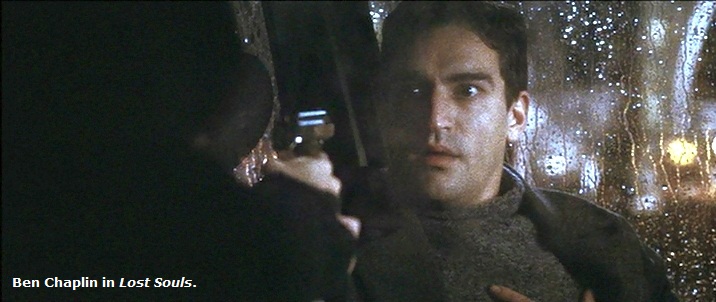
Lost Souls has a character shift that's similar to Gina's -- a scary transformation implied largely through acting. At the film's end, Peter (Ben Chaplin) is about to transform into the Antichrist at a specific time. (The date and time of his birth, 33 years ago.) He urges Maya (Winona Ryder) to shoot him after the transformation.


The time arrives and Peter insists that the transformation didn't occur. He begs Maya to put down the gun. Maya is confused. Should she put down the gun? Then the car's clock blinks 666 -- indicating that now the transformation has happened.


Ben Chaplin's expression changes, indicating that now Peter is the Antichrist.

Shifts in facial expression, especially when a trusted person is suddenly revealed to be evil, are an effective way of scaring audiences. Many examples exist. To cite just one more, consider Ray Wise's changes of facial expression to suggest Bob's possession of Leland in Twin Peaks.

===================

For more about acting techniques in horror films, see Horror Film Aesthetics: Creating the Visual Language of Fear. This blog represents a continuing discussion of my views on horror, picking up from where the book left off.