Friday, May 25, 2012

Tim Burton's Dark Shadows Fails Because It Subverts the Original Characters

The greatest strength and pleasure of TV's Dark Shadows (1966-71) were its characters. I doubt this Gothic soap opera was ever scary to an adult (though "the hand of Count Petofi" scared me as a child). The show is famous for its bloopers. Wobbly tombstones and boom mics in the frame. This is why some modern critics claim that the show's primary appeal is as camp comedy.

While the original Dark Shadows isn't particularly scary, especially in a modern horror context, I wouldn't call it camp. The show remains entertaining and engaging -- at times, even suspenseful, eerie, and poignant -- because of its characters.


Characters are created by the actor plus the script. Characters are what engage an audience. This is especially true of a TV series. Audiences tune in, sometimes for years on end, because they've come to love the characters. The plot is secondary.

Dark Shadows fans love the characters, and the actors who portray them. Jonathan Frid is Barnabas Collins. And although the character of Victoria Winters was always written true to form, I never could believe Betsy Durkin or Carolyn Groves as Victoria Winters. Only Alexandra Moltke (aka Alexandra Isles) is Victoria.

Many TV remakes fail creatively, even if the new script is true to the original character, because the lead actor is different. Patrick McGoohan is The Prisoner. Darren McGavin is Kolchak, The Night Stalker. Lindsay Wagner is The Bionic Woman. The remakes failed, and good riddance.

The 1991 Dark Shadows TV remake failed for many reasons. 1. The original was shot on a TV soundstage, which is more surreal and cozy then the remake's outdoor locations. 2. The original's daily half-hour installments maintained a long, drawn-out, suspenseful pace, which the remake's weekly one-hour installments couldn't duplicate. The former pacing worked better for the series' many characters and complex, interweaving storylines.


But the remake's biggest flaw was that it changed the characters. Not only did it cast new actors (unavoidable, but a still serious shortcoming), but the script subverted the characters. The original Maggie was a wholesome girl-next-door. The new Maggie was a slut. The original Roger was a prissy, stuffed shirt. The new Roger was a hunky beefcake.

In short, they were not Maggie and Roger. Not even parodies of Maggie and Roger.

With its new set of characters (both as written and as performed), the 1991 Dark Shadows was not a remake, but an entirely new show. Yes, it poached the original characters' names, and some plot points, but that made for a remake in name only.

Sometimes classic characters are reimagined (e.g., Sherlock Holmes, James Bond, Ebeneezer Scrooge). But you can only reimagine a character so far, before it becomes an entirely new character.

Tim Burton's 2012 Dark Shadows film is not a remake, but a parody of the original TV series. Parodies are a tricky thing. Parody characters are shallow duplicates; neither the original characters, nor substantive characters in their own right. They are caricatures to laugh at, rather than the original people the fans care about.


Perhaps Burton understood that Dark Shadows could not be remade on any serious level. Not only is the original cast unavailable, but the original characters were written with a white bread innocence (WASPy wholesome girls and respectful young gentlemen, albeit amid vampires and witches), that would be laughed at by many of today's young viewers.

Dark Shadows's original characters are the stuff of nostalgia for a simpler place and time: the fictitious town of Collinsport. The show ran during turbulent times (1966-71), with nary a mention of Vietnam, race riots, or bra-burning. Despite its horror content, the series emotionally cocooned audiences from "relevant" topics. A cocooning aesthetically supported by the show being shot on soundstages, which, as I noted above, are more cozy and surreal than are (more realistic) outdoor locations.

Burton's Dark Shadows does what Hollywood does best: makeup and special effects. Much of the new cast look like the original characters, but these caricatures are not written as the original characters. And because the characters are different, the film fails as a remake.

Fans seeking a remake will be disappointed -- and I suspect that few fans will be satisfied with a mere parody.

=====================

For more about actors in horror, and about the relationship between horror and comedy, see Horror Film Aesthetics: Creating the Visual Language of Fear. This blog represents a continuing discussion of my views on horror, picking up from where the book left off.

Sunday, May 13, 2012

The Broken: A Character's Facial Shift as Horror

Horror may be defined as the realization that "the world isn't the same as our minds believe" (to cite the bounty hunter, Rogan, in Fox TV's Werewolf). Likewise, horror can be the realization that an intimate loved one is not who you believed them to be. Or that you yourself are not who you believed yourself to be.

This revelation of someone being other than they appear to be can be done through special effects, but I am especially impressed when it's conveyed through story and acting alone (e.g., a shift in facial expression).

In The Broken (2008), Gina (Lena Heady) suffers a car crash. Physically okay, she is now plagued with amnesia -- and a growing suspicion that she has a double (i.e., a doppelganger, though that term is not used) who is somewhere out there, following her. Why?

Gina then grows suspicious that her boyfriend, Stefan (Melvil Poupaud), is not her boyfriend. That he's been replaced by his doppleganger.

If it sounds like Invasion of the Body Snatchers, that's no accident. The Broken pays direct homage to the 1978 remake when a frightened Asian man tells Gina's brother, Daniel (Asier Newman), "That's not my wife."

The Broken's conceit is supported by a creepy atmosphere that's achieved through 1. long stretches of silence (occasionally supported by some unsettling ambient noise), and 2. extreme closeups of mundane objects.

(David Lynch has used these same techniques to great effect, and The Broken continues borrowing from Lynch through to its penultimate scene, with a musical score that's reminiscent of the one at the end of Mulholland Drive.)

The Broken packs its greatest emotional punch at films end. Actually, two punches.

The First Punch is in the penultimate scene, in the form of a Big Revelation. Gina's long hunt for her doppelganger ends when she discovers her own dead body in her apartment, whereupon Gina's amnesia lifts and she remembers that She is the doppelganger!

Naturally, she is distraught by this revelation, in an emotional scene that is supported by The Broken's Lynchian music score.

I saw this revelation coming about 15 minutes before it did. It's not too original a plot twist. Many films have protagonists who discover at the end that they're really the villain (Total Recall, Thr3e, Number 23), or really the good guy (Murder by Night), or a ghost (The Sixth Sense, The Others) or dead (Jacob's Ladder). Ideally, the audience is likewise surprised. Having empathized with the protagonist, they emotionally share the protagonist's shock and distraught.

But it's The Broken's final scene that makes it a truly great horror film. Its Second Punch is a Personality Shift that is one of the scariest horror scenes of the past decade. It's a scare that's achieved without special effects, but through story and acting alone.

In this final scene, Gina is at work, knowing that she is a doppleganger. She exits the room to see her brother, Daniel, in the hallway. She'd earlier warned Daniel about the doppelgangers. Daniel has by now seen the personality transformation in his fiancée.

We'd last seen Gina as a sympathetic character. A woman distraught at learning that, before her amnesia, she had been a murderous doppelganger.


She approaches Daniel, a blank look on her face. Is she still the sympathetic doppelganger with a conscience? We can't tell from her expression.


Daniel stares at her. Saying nothing. Wondering if she's now also one of them. (She always was, though she -- and he -- didn't know it.)


An expression of hate clouds Gina's face. The same cold hate we'd seen on the other doppelgangers. The camera moves in closer to emphasize Gina's expression. She remains silent. No warm words of greeting to her brother.

Whereupon Daniel runs away in fear.

This is the Second Punch. It's the scariest scene in the film because we have grown to empathize with Gina. She had been warm and loving. The First Punch was shocking, but it didn't mean we couldn't continue sympathizing with her as a doppelganger. Bruce Willis remained sympathetic in The Sixth Sense, though he turned out to be a ghost. Arnold Schwarzenegger remained a hero in Total Recall, though he learned that he had been an evil government agent before his memories were removed.

Gina's emotional acceptance of her villainy is the real terror of The Broken. Not the initial terror of her being stalked by doppelgangers. Not the second terror of discovering that she's one of them. But the final/third terror of her embracing her dark side -- of her personality transforming into entirely new person.

Some monsters resist their dark side. Gina didn't. She became evil before our eyes. A transformation achieved largely through Headey's performance.

Daniel's discovery of Gina's personality shift evokes Invasion of the Body Snatchers's scene where Nancy discovers that Matthew has become a pod person. In both films, a frightened mortal approaches a trusted friend, only to have that friend's face reveal that they are no longer the same. But Donald Sutherland's monster -- although suggested by his performance -- also benefited from the sound effects emanating from his mouth. Not so with Lena Heady.

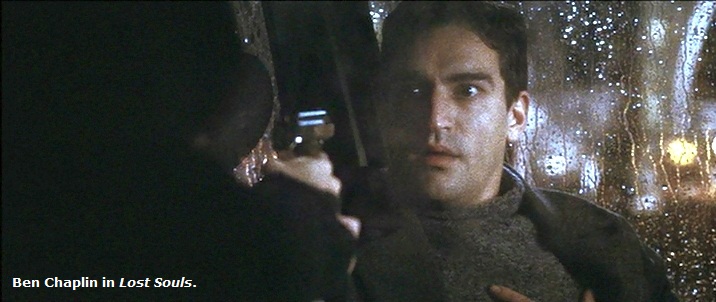
Lost Souls has a character shift that's similar to Gina's -- a scary transformation implied largely through acting. At the film's end, Peter (Ben Chaplin) is about to transform into the Antichrist at a specific time. (The date and time of his birth, 33 years ago.) He urges Maya (Winona Ryder) to shoot him after the transformation.


The time arrives and Peter insists that the transformation didn't occur. He begs Maya to put down the gun. Maya is confused. Should she put down the gun? Then the car's clock blinks 666 -- indicating that now the transformation has happened.


Ben Chaplin's expression changes, indicating that now Peter is the Antichrist.

Shifts in facial expression, especially when a trusted person is suddenly revealed to be evil, are an effective way of scaring audiences. Many examples exist. To cite just one more, consider Ray Wise's changes of facial expression to suggest Bob's possession of Leland in Twin Peaks.

===================

For more about acting techniques in horror films, see Horror Film Aesthetics: Creating the Visual Language of Fear. This blog represents a continuing discussion of my views on horror, picking up from where the book left off.

Saturday, April 14, 2012

La muerte incierta Demands DVD Release

It seems that most significant (and a great many minor) horror films have by now been released on DVD. Even more titles are available on VHS, if only as used copies. Yet a few stragglers remain. Horror films that one has read of, but never seen.

Some of these lost films may be found on bootleg or file-sharing sites, or even on Ebay. Apparently, a loophole in copyright law allows an out-of-print film to be copied and sold. (At least that's what one seller told me.)

But one horror film that remains elusive, though I've sought it since the 1990s, is La muerte incierta.
 
This Spanish film was released in 1973. The Internet Movie Database says that it also has an Italian title: La morte incerta. But the IMDb lists no English title. Perhaps the film was never released in an English-speaking country?

My favorite online translator translates the Spanish tile as The Uncertain Death, the Italian title as Death Uncertain.

Certainly, La muerte incierta is an obscurity. I've never met a horror fan who's ever heard of it, though it's been talked about online. As best I know, the film was never released on home video in any format. It might not ever have had an American theatrical release.

Even so, La muerte incierta is not without a respectable pedigree. The film was directed by José Ramón Larraz, who is perhaps best known to horror fans for Vampyres (1975). It also features actress Rosalba Neri (The Devil's Wedding Night).


But I'm most interested in La muerte incierta because it features my favorite obscure British horror actress: Mary Maude.

Maude may be best known to horror fans for her role as the sadistic schoolgirl in
The House That Screamed (aka, La residencia). Maude told Filmfax No. 75-76 that she considers her work in the film only half a performance, because her voice was dubbed by another English actress. Maude was working on another project at the time of dubbing, and thus was unavailable.

Maude's only other starring role in a horror film was in the oddball Crucible of Terror, though she also had a bit part in Terror (British 1978).

As you can see, Maude's body of work in horror is small. Which makes me all the more curious to see La muerte incierta.

Considering that La muerte incierta involves José Ramón Larraz, Rosalba Neri, and Mary Maude, I think there's a decent-sized market for it, should any DVD distributor be paying attention.

Of course, there's always the grim possibility that the film is truly lost. All copies trashed or burned or destroyed beyond repair. All that remains are some posters and lobby cards, and a trailer. Hints of what might once have been.

============================

For more about obscure, "must see" horror films, see Horror Film Aesthetics: Creating the Visual Language of Fear. This blog represents a continuing discussion of my views on horror, picking up from where the book left off.
Tuesday, March 13, 2012

Moving Shots Enliven a Static Threat (e.g., The Great Alligator and The Creepy Doll)

Sometimes a horror filmmaker faces the problem of making a “static threat” appear frightening. For instance, a cheap monster prop that doesn't move. Not all filmmakers can afford expensive electronic puppets or CGI effects. In such cases, a moving shot (aka a moving frame) can help enliven the static prop.

In the 1979 Italian film, Il fiume del grande caimano (aka The Great Alligator, The Big Alligator River), director Sergio Martino has a giant alligator prop that resembles a floatation device. The prop can swish its tail, but that's about it.

However, Martino makes his alligator appear more lively by panning his camera along the alligator. Sometimes, the alligator prop is pushed in one direction while Martino's camera pans in the opposite direction. Or the prop is pushed toward the camera, which pans to the side. This interplay of movement enlivens the prop.

It's still obviously a prop, but the moving camera helps audiences suspend their disbelief. And because The Great Alligator is a highly entertaining film, many viewers will want to suspend their disbelief, and thus are already halfway there, provided that Martino helps them along. As he does with his moving camera.

In addition to his moving camera, the silliness of Martino's alligator prop is further mitigated by tight framing (only parts of the alligator appear in the frames -- his foot, his snout, his tail, etc.), and brief shots (because these these quick cuts are of short duration, audiences lack the time to mentally digest and contemplate the lameness of the prop onscreen).

Here's a fine alligator attack scene from The Great Alligator (the poor sound is my ineptitude). Observe the 1. moving frame, 2. tight frame, and 3. brief shots, and consider how they help the alligator prop appear more lively and less silly.


Now compare to this earlier scene from The Great Alligator. Here Martino uses some tight frames, but lets in a wide frame, allowing us to see the alligator prop in full. Not very impressive, is it?


Despite its shortcomings, The Great Alligator is a highly enjoyable Jaws ripoff. I've seen it many times and recommend it.

P.J. Woodside, director of The Creepy Doll, was likewise faced with the problem of a static threat -- that of a doll. The doll never moves or talks. (Once, near the end, it changes expression.) The Creepy Doll is a subtler, more psychological horror film that many contemporary horror films.

How to promote a horror film to audiences, when its threat is so static? How to present this threat in a trailer?

Woodside's solution was to move her camera around and about the doll, sometimes just bobbing a bit, as demonstrated below:


It works. Woodside's moving camera helps enliven the doll, implying that a dark mind lurks beneath its plastic, painted surface.

============================

For more about framing and editing in horror films, see Horror Film Aesthetics: Creating the Visual Language of Fear. This blog represents a continuing discussion of my views on horror, picking up from where the book left off.

Saturday, March 10, 2012

How Christianity Functions in Absentia

Interpreting a film for symbols and themes is a somewhat subjective process. I liken the interpretive process to an asymptotic curve.

In Mike Flanagan's Absentia, the Christianity is subtle but explicit. Buddhism also makes an appearance. Why are these religions in the film? Do they serves a function?

Absentia is about two sisters, Trish and Kelly, who live near a portal to another dimension. A dimension inhabited by Lovecraftian demons. The sisters are unaware of this. Or that it was a demon that abducted Trish's husband seven years ago.

Trish is a Buddhist. Kelly is a Christian. Trish meditates with incense and a gong. Kelly prays before a crucifix on her bedroom wall. The sisters occasionally discuss their respective religions. Thus, Absentia's religious elements are explicit.

But not much is made of these elements. The sisters' discussions are brief and without conflict. Thus, while the religious elements are explicit, they are also subtle.

How do these religious elements serve the film?

Spoilers ahead...


Eventually, the demon abducts Trish. Kelly offers herself up to the demon in exchange for Trish. At the last minute, Kelly changes her mind and flees. To no avail. The demon takes Kelly -- and keeps Trish.

Actress Katie Parker (who plays Kelly) suggested at a recent screening that Kelly's Christianity and Trish's Buddhism were intended to emphasize the monster's power -- that no religion could protect you.

Yes, I can see that interpretation. But I also see how Absentia's religious elements function in other ways:

1. Kelly's explicit Christianity adds subtext to the story. It fleshes out her character.

2. Her Christianity provides motivation for her character when she offers to sacrifice herself for Trish. That Kelly changes her mind and flees demonstrates that she's still human and flawed (i.e., only Christ is perfect.).

Apart from her Christianity, two other factors motivate Kelly's intended self-sacrifice: 1. Her love for Trish, and 2. Her hurt and guilt over Trish having called her a prodigal sister. Kelly is hurt by this comment and wants to prove Trish wrong. And Kelly feels latent guilt; a part of her worries that there's truth to Trish's accusation.

As for Trish's Buddhism, I think it's there to offset Kelly's Christianity, for two reasons.

1. Some viewers may think the film too preachy if Christianity is the only religion portrayed in an explicitly positive manner.

2. Some viewers regard Christians as bigots. This preconception is proven wrong by Kelly accepting her Buddhist sister. Thus, Kelly's reaction to Trish's religion further fleshes out Kelly's character (i.e., she is a humble and tolerant Christian).

Trish's Buddhism acts as foil for Kelly's Christianity (i.e., Trish's Buddhism functions more to flesh out Kelly than Trish).

============================

For more about interpreting themes and symbols in horror films, see Horror Film Aesthetics: Creating the Visual Language of Fear. This blog represents a continuing discussion of my views on horror, picking up from where the book left off.

Monday, February 13, 2012

Parody vs. Mash-Up -- Contrasting Waxwork II: Lost in Time with The X-File's "The Post-Modern Prometheus"

The parody is a relatively easy subgenre to create, because all the main story elements -- the characters (their attitudes, mannerisms, physical appearances), the dramatic situations, the cinematographic and audio styles -- are given to the parodist. Filmmakers and writers who tackle other genres must strive to create original characters and storylines -- an effort that does not burden parodists.

Waxwork II: Lost in Time (1991) demonstrates how easily a lazy filmmaker can create serviceable entertainment when parodying past films. By contrast, "The Post-Modern Prometheus" episode of TV's The X-Files shows how a filmmaker can build upon parodied elements to create something new and worthwhile.

Waxwork II is a sort-of anthology film that parodies previous horror films. Its two lead characters, Mark and Sarah, enter a time warp that sends them through various scenarios, each evoking a horror film.

At one point Mark finds himself with a group of ghost hunters, about to explore a haunted house. Horror fans will immediately recognize the tale as parodying The Haunting (1963). Waxwork II borrows the characters (as in the original, two men and two women), some of their names (both films contain an Eleanor), their attitudes (in both films, an assertive lesbian hits on a timid Eleanor; the lead investigator is a stuffy scientist), the black and white cinematography, and many situations (the laughing girl behind the door).

Waxwork II offers a few original bits, but with rare exception (John's exposed ribs), the film's original elements are unfunny. All the real humor derives from mimicking The Haunting.

Thus, the parodied elements act as a crutch for an otherwise unfunny comedy.

Examine how slavishly the parody mimics the original, in both content and style (and these are only a few of many examples):


This slavish mimicry is true throughout Waxwork II. In another vignette, Sarah finds herself on an alien spacecraft. Very quickly, horror fans will recognize this as a parody of Alien (1979). The astronauts' uniforms resemble those in Alien. Sarah's hair mimics Ripley's hair. The astronauts are cynical and slovenly. And they're being pursued by an alien that bursts from people's chests.


In both of the above vignettes, the audience's pleasure derives not from original characters or situations created by the filmmaker, but from the audience's sense of recognition at identifying which film this or that scene is lifted from.

Of course, many comedies, not just parodies, derive laughs from a sense of recognition. But whereas other comedy subgenres must strive to create original characters and situations from which to draw that sense of recognition, parodies can all too easily get lazy and rely solely on a mimicry-based sense of recognition.

All this is not to say that a slavish parody can't be entertaining -- just that it's a relatively easy and lazy form of filmmaking.

By contrast, consider "The Post-Modern Prometheus" episode of TV's The X-Files. This TV episode simultaneously parodies multiple targets (not just one source film per vignette), then blends all these targets together, while also adding strong, original elements (e.g., series leads Mulder and Scully), to create something new that can stand on its own merits.

In "The Post-Modern Prometheus," Mulder and Scully are presented in 1930s black and white, in a story that borrows characters, situations, and themes from Frankenstein, The Elephant Man,The Mask, and Edward Scissorhands (particularly the episode's music -- check the YouTube excerpt below), and then juggles and mixes these disparate elements into an original, compelling, and cohesive story.


By cohesive, I mean that the story is not just a disparate sequence of random parodied targets, but that all the elements -- Mulder and Scully's characters and attitudes, the original story elements, the parodied targets -- hold together (every element aesthetically and dramatically supporting the other elements) and create a unified story, one that is both unexpectedly funny and surprisingly poignant, while remaining true to Mulder and Scully's personalities.

That is to say, "The Post-Modern Prometheus" works as an The X-Files episode. It does not feel as if Mulder and Scully are slumming in an unrelated "very special episode" because the writers couldn't think of an The X-Files episode that week.


By contrast, Waxwork II feels unfocused and overlong. The main (original) characters are not interesting in themselves. They exist for no purpose other than to meander about as props in the increasingly dull and obvious parody vignettes. Tellingly, the film's most original vignette (the medieval story) is also its most tedious.

Unlike Waxwork II, "The Post-Modern Prometheus" is not only a parody -- it's a mash-up. The former over-relies on borrowed elements as a crutch. The latter borrows smaller bits from many sources, adds large doses of originality, then mixes it into something wholly new.

=====================

For more commentary about the relationship between horror and comedy, see Horror Film Aesthetics: Creating the Visual Language of Fear. This blog represents a continuing discussion of my views on horror, picking up from where the book left off.

Thursday, February 2, 2012

The Ghost and Us: Showing, Not Telling

Emily Carmichael's horror comedy short film, The Ghost and Us, provides an excellent working example of the old screenwriting rule, Show, Don't Tell.

In the film, Laura (Maria Dizzia), is newly married to a man she loves. Ben (Geordie Broadwater) loves her back. The problem is that Ben's ex-wife, Sena (Moira Dennis), won't let go. She keeps dropping by unannounced. Laura even finds Sena in the newlyweds' bedroom, whispering sweet nothings into Ben's ear.

Laura can't even get a restraining order against Sena, because ... Sena is dead. The woman isn't just a stalker, she is a spiritual stalker.

(Yes, The Ghost and Us evokes Blithe Spirit.)

Despite its short length (11 minutes), The Ghost and Us provides story arcs for all three of its characters (wife, husband, dead wife). All three characters change in some small way by film's end.

Especially admirable is the film's mid-point scene. As Syd Field teaches, the mid-point is where one should normally place a film's key turning point/incident -- an incident that affects the main characters' story arcs. The Ghost and Us not only achieves this, but it does so by showing, not telling.

Prior to this mid-point scene, Laura and Sena have battled and bickered over Ben's affections. The mid-point scene begins after Laura and Sena have engaged in a temporary truce. Together, they share a snack in the kitchen. Girl stuff of the sort that bonds women.


Then it becomes apparent that Sena cannot eat. She's a ghost.

Laura's attempt to help Sena eat, and the latter's realization that she's no longer of this world, both strengthens their bond, and conveys a poignancy that lifts The Ghost and Us above a mere spook tale. Adding to the scene's strength is that:

1. It's conveyed visually. Rather than having the two women say nice things about each other, Carmichael shows Sena's inability to eat, and Laura's futile attempt to help her rival.

2. It's not overdone or overlong. The incident occurs. It's over. The women return to battle. (Albeit with a greater understanding of their situation, and of each other, hence, their emotional story arcs are advanced.) By not belaboring this scene, The Ghost and Us avoids the trap of cheap sentimentality.

Actually, The Ghost and Us is admirable for just having a story and characters. All too many horror films these days are just an unmotivated succession of scenes which contain nothing but gore effects.

Emily Carmichael is an NYU film school graduate whose work has screened at the Sundance Film Festival. She may be contacted at Kid Can Drive.

=====================

For more commentary about horror films, see Horror Film Aesthetics: Creating the Visual Language of Fear. This blog represents a continuing discussion of my views on horror, picking up from where the book left off.