Saturday, May 28, 2011

Drag Me to Hell -- Subversive Threat Can Heighten Fear, But Is Overlooked

A reviewer on Amazon claims that Lost Souls is subversive to Christianity. I disagree. In Lost Souls's retelling of Revelation, God is good, Satan is evil. Good defeats evil. Lost Souls introduces its own theological details, but Christian fundamentals are affirmed.

By contrast, Drag Me to Hell introduces a potentially powerful -- and frightening -- concept: Mere mortals have the power to damn people to Hell.

In Drag Me to Hell, Christine (actress Alison Lohman), is a bank loan officer who refuses a mortgage extension to an old gypsy woman. Outraged, the gypsy curses Christine so that she will die in three days, after which she will burn in Hell for eternity.

Normally, curses in horror films inflict earthly torment or death on a victim. Once you die, the curse can't follow you. Only God determines who goes to Hell.

You can damn your soul to Hell. You might commit a grave sin, or sell your soul to Satan. But it was your evil act -- your willful disobedience to God's law -- that sent you to Hell. Mortals cannot send innocents to Hell. Not even Satan can do that.

Not so in Drag Me to Hell.


Christine is a good person. She doesn't do anything Hell-worthy. She even tries to convince her boss to grant a mortgage extension to the gypsy. True, the boss leaves the final decision to Christine, albeit indicating that he prefers the extension be denied. But denying a loan extension -- to a bad risk who's already had two extensions -- is not Hell-worthy.

Drag Me to Hell's core concept -- that evil mortals can damn people to Hell -- heightens the threat, and thus the potential fear. For those who accept Christianity, and can suspend disbelief for the duration of this film, this is creepy stuff. Twilight Zone/X-Files type creepy. As in "the world is not as our minds believe."

Horror films have introduced new rules into theological tales (e.g., Lost Souls, The Sentinel, Child of Darkness, Child of Light). That's not a problem. For a Christian horror fan, it can be quite entertaining. The problem with Drag Me to Hell is that it introduces a new rule, one with great potential to heighten the fear -- then ignores it.

Filmmakers Sam and Ivan Raimi seem unaware of their own film's fear potential. Their threat -- a mortal empowered to damn innocents to Hell -- seems inadvertent and unnoticed. Drag Me to Hell makes no special mention of this startling departure from core Christian theology.

No character in the film remarks, "Wait a minute -- can a gypsy do that?" Christine does not consult a priest or minister -- only a (pagan?) psychic. She seeks supernatural help, without struggling with this new and mind-boggling (to a Christian) concept.

A Google search shows that Sam Raimi is Jewish, which may explain his failure to realize the potential power of his idea for Christian horror fans.

Drag Me to Hell focuses on traditional horror film elements -- spooky atmosphere and sudden shocks -- rather than the intellectual and metaphysical implication of its threat.

It's still an enjoyable film. The atmosphere is spooky, the shocks are there. Slick production values and an overall fine cast. It even co-stars Justin Long of the excellent Jeepers Creepers. (Always nice to see Long in a horror film.) But Drag Me to Hell might have been so much more had it spent some time exploring the notion that a mortal has the power to damn innocents to Hell.

Offhand, I recall only one other horror film which features a mortal with the power to damn people to Hell. It's a short film called Mr. Buttons, which was submitted to my Tabloid Witch Awards in 2007.

A Wiccan priestess empowers this clown doll, Mr. Buttons, to grant wishes. A woman wishes her brother to Hell for eternity when he dies, and the doll complies.

Again, Mr. Buttons didn't make much use of this premise. Only at film's end do we learn the woman's wish, or that the doll has the power to grant it. As in Drag Me to Hell, this concept is passed over so quickly, I'm not sure filmmaker David Quitmeyer understood his idea's potency.

Apart from its strong ending, Mr. Buttons has rough production values and is not noteworthy. A decent effort by a beginner filmmaker, but no more.

=======================

For more about the nature of threats in horror films, and the nature of the pleasures that come from viewing them, see Horror Film Aesthetics: Creating the Visual Language of Fear. This blog represents a continuing discussion of my views on horror, picking up from where the book left off.


Thursday, May 19, 2011

Saturn Award Ignores Grassroots Horror for Studio Product

Every year, the Academy of Science Fiction, Fantasy & Horror Films presents its annual Saturn Awards. The Academy claims that its goal is to recognize genre excellence.

The problem is, it doesn't even try to do so.

The Academy's genre definitions are so elastic, all manner of non-horror (and non-science fiction/non-fantasy) films qualify for Academy screenings and Saturn Awards.

Who or what is to blame? Among the prime culprits are studio publicists.

I wrote about this problem back in 1997. My article eventually saw print in 2001.

It's now available for free online at Communist Vampires.

Sunday, May 8, 2011

“So Bad It's Good” vs. “Suspension of Disbelief”

At last weekend's World Horror Convention, I served on a panel entitled: Why Do Horror Films Suck?” I challenged the panel's premise, explaining that I can enjoy even technically inept horror films.

Another panelist, author Scott Browne, agreed, saying that some films were so bad, he found them entertaining.

Yet that's wasn't quite what I meant. I gave it some thought after the panel, and had an epiphany.

I enjoy “bad” horror films, but not because they're “so bad they're good.” I enjoy them for the same reason that I enjoy “good” horror films -- because my “suspension of disbelief” filters out elements that hinder my enjoyment.

Film theorists have long said that, to enjoy a film, the viewer must “suspend disbelief.” We know those are actors on the screen, not real people, but we shove that thought from our minds. We know horses can't talk, Superman can't fly, and ghosts don't exist, but we shove that thought from our minds.

It's the same with technically inept films. Watching a technically great ghost film like The Haunting requires a certain suspension of disbelief. Watching an inept ghost film -- with wooden acting, cheap sets, poor atmosphere, and a microphone that occasionally drops into the screen -- also requires suspension of disbelief, but more of it.

I tell myself: “Okay, I'll ignore that ghosts don't exist -- and I'll pretend those are real people on screen despite their bad acting, and I'll pretend I didn't see that boom mic's shadow against the wall.”

To suspend disbelief over a film's ineptitude yields a different quality of pleasure than enjoying a film because “It's so bad it's good.” In the former case, the viewer may yet enjoy some fear or suspense, because one still believes the story on screen. In the latter case, the viewer has given up all attempts at believing in the story (suspension of disbelief is broken), and just laughs at the bad actors stumbling about the cheap sets.

I have a high tolerance for inept horror films. I can suspend my disbelief even for films like Blood Feast and Horror of Party Beach, and enjoy their stories. (Although, I've seen so many horror films, it's hard for me to feel fear from any of them, however hard I try to suspend disbelief.) Other people have a lower tolerance, and can only enjoy these films on a “so bad it's good” level.

There is also a gradation. One may suspend disbelief to a certain (greater or lesser) degree for some films, while enjoying part of these films for being “so bad it's good.” (I can enjoy The Great Alligator on both levels.) Naturally, the more inept the film is, the more this ineptitude wears away at viewers' suspension of disbelief.

I've long held that a film should be judged both Objectively and Subjectively.

Some horror films are Objectively and Subjectively great. They meet the high standards of defensible, objective criteria -- and I greatly enjoy them. For example, The Haunting and Lost Souls.

Other films are only Subjectively great. I greatly enjoy them, yet I see their technical faults. For example, Stage Fright or Crucible of Terror.

Even so, despite technical shortcomings, such films can still have some Objective merit due to their admirable use of pragmatic aesthetics (i.e., using those technical shortcomings in ways that support the characters, story, or themes).

In summary, by suspending disbelief, one can enjoy a technically inept horror film despite its ineptitude, rather than because of it.

=======================

For more about interpreting horror films, and the nature of the pleasures that come from viewing horror, see Horror Film Aesthetics: Creating the Visual Language of Fear. This blog represents a continuing discussion of my views on horror, picking up from where the book left off.

Saturday, April 23, 2011

Kay Lenz's Performance in The Initiation of Sarah

The Initiation of Sarah (1978) is my favorite horror TV movie from the 1970s -- a decade famous as a Golden Age of horror TV movies. It's a Carrie ripoff, but as occasionally happens, it's better than the original.

As with Carrie, The Initiation of Sarah is about a nerdy girl with psychic powers (Sarah, portrayed by actress Kay Lenz) who is bullied by female classmates. This time it's college, rather than high school, but it's essentially the same story.

Because The Initiation of Sarah is a TV movie (and shot in the more innocent 1970s), it has less gore than Carrie. This means that Sarah must rely on other strengths. Without taking anything away from Carrie's Sissy Spacek, Sarah's greatest asset, among many, is Kay Lenz's performance as the nerdy Sarah.

Lenz's physical appearance, body language, mannerisms, and expressions consistently capture the nuanced timidity of a girl nerd. Consider Sarah maneuvering silently amid the ANS partygoers. (See below clip.) In her dowdy cardigan sweater, the 5'1" Lenz holds herself together, trying to avoid touching anyone as she squeezes past the exuberant taller girls chattering over her. The insecure Sarah strains to be inconspicuous, painfully self-conscious despite the beautiful ANS (Alpha Nu Sigma) girls' obliviousness to her.


It's a short scene, but The Initiation of Sarah is full of such moments when Lenz shines as Sarah. Unfortunately, the above clip seems out of sync, but focus on the visuals and you'll see what I mean.

The one flaw in Lenz's portrayal is when the ANS girls fling mud and vegetables at Sarah, who stands screaming rather than retreat into the house. Most likely, this was Robert Day's direction. A small mistake, in an overall fine job as director. (No, I don't buy that Sarah was "too shocked" to move; I rarely buy that horror's legions of screaming women are too shocked to move whenever a monster lumbers toward them.)

Carrie was remade starring the admirable Angela Bettis, one of the few current actresses who could equal, if not excel, Spacek's performance. I think of Bettis as a female Anthony Perkins; her character in May has a Norman Bates quality. Creepy, yet vulnerable and sympathetic.

It's possible that The Initiation of Sarah was likewise remade, though its DVD description indicates that the producers merely reused the title for an entirely different story. I've not seen this "remake," because most horror remakes of the past 15 years (unlike the ripoffs) have been dreadful, so I can't say for sure.

=======================

For more about the staging and performances of actors in horror, see Horror Film Aesthetics: Creating the Visual Language of Fear. This blog represents a continuing discussion of my views on horror, picking up from where the book left off.


Sunday, March 27, 2011

In Body of Work Realistic Acting Enhances Supernatural Horror

Like any art form, acting encompasses many styles. Certain styles are more aesthetically supportive of a film's story, characters, and themes than are other styles.

Acting can be theatrical and melodramatic (Who's Afraid of Virginia Wolfe, House of Yes), slightly theatrical and "stylized" (Bram Stoker's Dracula), hyper-stylized to the point of parody (Streets of Fire), hammy (Children Shouldn't Play with Dead Things, Blood Feast), deadpan (The Unbelievable Truth), scenery-chewing (William Shatner or Grayson Hall), or have the adults behave like children (Freaky Farley).

(No, I don't know every acting style out there; I'm sure many have yet to be discovered or invented.)

Filmmaker Alex Bram (Body of Work) believes that realistic acting is especially beneficial for supernatural horror. Bram says: "I am devoted to realistic acting, although I work in a surreal genre. So often, the unrealistic and cartoon style acting seems to creep into these kinds of movies."

Here's a trailer for Bram's supernatural horror short film, Body of Work:


Realistic performances help ground the Unnatural in reality, making the unreal seem real to audiences.

Critics have noted that one of Kolchak: The Night Stalker's strengths was that the show's supernatural monsters were offset by the cynical journalist, Carl Kolchak. If such a well-grounded character believed in the show's supernatural story elements, the viewer would more easily suspend disbelief.

The X-Files similarly set the Unnatural in a realistic milieu, with FBI Special Agent Dana Scully serving as the show's cynic. (Of course, since Kolchak had no partner, he was both Scully and Mulder, his character arc beginning the series as Scully, then growing over time into the more open-minded Mulder).

Realistic acting isn't always the best choice for a horror film, but it's a style that filmmakers might consider if the film's Unnatural Threat is especially incredible.

=======================

For more about acting styles and Unnatural Threats, see Horror Film Aesthetics: Creating the Visual Language of Fear. This blog represents a continuing discussion of my views on horror, picking up from where the book left off.
Saturday, February 26, 2011

Editing: An Unnerving Shot Sequence in Galaxy of Terror

This shot sequence from Galaxy of Terror twice misleads the audience by raising -- and then denying -- their expectations, unnerving them for the final shock.

The setting is inside a spaceship on a hostile planet. Ranger (Robert Englund) has just seen Captain Trantor (Grace Zabriskie) on a video monitor, apparently injured near an air lock. He rushes out of the room, toward the air lock.

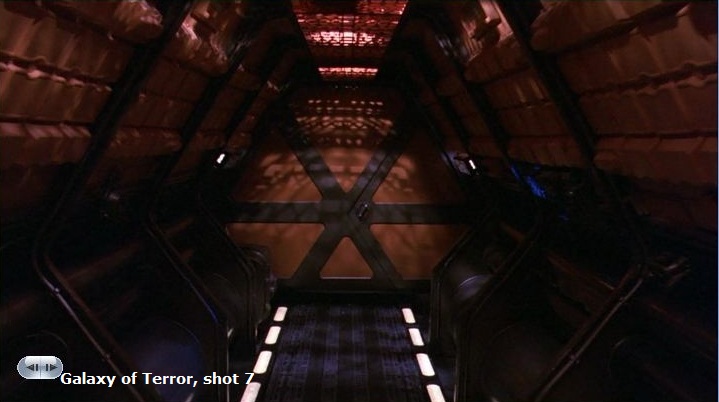
We begin with this objective shot of Ranger running through a corridor:


We cut to a subjective shot of his POV rushing through the corridor:


Cut back to an objective shot of Ranger:


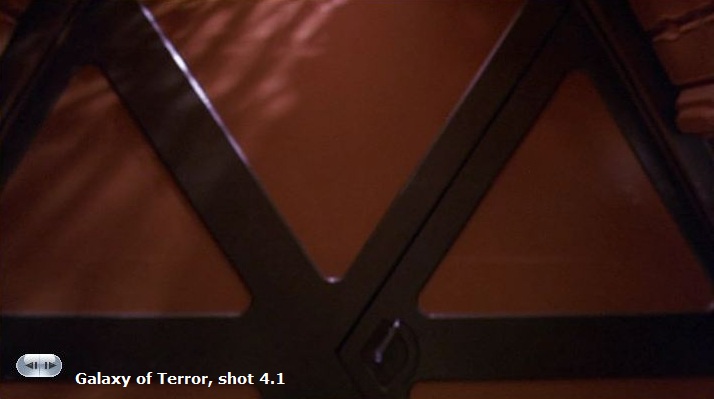
Cut back to a subjective shot of his POV, rushing toward this door:


But then the door opens -- and out comes Ranger!

We were fooled! Shot 4, unlike Shot 2, was not subjective! Not Ranger's POV.

By misleading viewers, director Bruce D. Clark has unnerved the audience, fraying its nerves for potential future shocks.


Cut to what looks like Ranger's moving POV:


And once again, the subsequent shots alternate between what appear to be subjective and objective shots.


Ranger approaches yet another door.

This appears to be his POV moving toward the door:


Will we be fooled yet again? When the door opens, will Ranger enter or exit from the doorway?


Neither!

The door opens -- and out comes the burnt body of Captain Trantor!


The previous misdirection in Shots 3/4 lowered our expectations for anything gruesome exiting from the second doorway, making Trantor's appearance all the more shocking.

===================

For more about how horror uses editing, and the difference between shocks vs. frights, see Horror Film Aesthetics: Creating the Visual Language of Fear. This blog represents a continuing discussion of my views on horror, picking up from where the book left off.

Also read my post on how editing misleads audiences in Vacancy.

Friday, February 25, 2011

What Is An Unnatural Threat -- And Why Does It Matter?

Horror requires an Unnatural Threat. Slasher films without an Uberpsycho (an indestructible, superhuman slasher, such as are Myers or Jason) lie closer to suspense/crime thrillers than to horror. Weak, pathetic slashers (e.g., Maniac, Don't Go in the House) are Natural Threats, hence, only tenuously horror.

Why does it matter? What differentiates a Natural Threat from an Unnatural Threat?

The quality of fear.

Compare these scenarios:

1. You're at home, alone with a loved one. Just the two of you. Someone you've known and loved and trusted for many years. Say, a husband. You're talking intimately. Suddenly, he pulls a gun on you, snarling, saying he's hated and lied to you all these years, and now he will kill you.

Horror? No, the threat is natural. Happens every day. It's shocking and frightening, but the tale could as easily make for a crime thriller, a suspense film, or a soap opera.

2. You're at home, alone with a loved one. Just the two of you. Someone you've known and loved and trusted for many years. Say, a wife. You're talking intimately. Your wife enters the bathroom, leaving the door ajar. You see her reflected in the mirror, though she doesn't realize that you see her. As she calls out to you, cheerful and loving, she reaches under her chin and peels off her face, revealing a hideous alien. A bizarre hole in her "face" continues shouting to you, in her lovely voice, cheerful and friendly. Her eye-thing glances into the mirror and sees you watching her...

That's horror. That's an Unnatural Threat. The quality of fear differs. The Ring and The X-Files inspire a qualitatively different fear from the fear evoked by Saving Private Ryan, Death Wish, or Underworld.

An Unnatural Threat evokes both fear and a sense of wonder. An Unnatural Threat is awesome and mesmerizing. This is why an Unnatural Threat packs a stronger emotional punch than does a Natural Threat.

Some films do qualify as horror, despite their Natural Threats. I'm talking about the Naturalistic Psycho Gorefest, whose killers are colorful and bizarre (not weak or pathetic), as is found in Texas Chainsaw Massacre or House of a 1000 Corpses).

But because the quality of fear differs from unnatural psychos, I'm inclined to think that the Naturalistic Psycho Gorefest is not a horror subgenre, but an entirely different horror genre.

=======================

For more about Unnatural Threats, Uberpsychos, Apparent Uberpsychos, and Naturalistic Psycho Gorefests, see Horror Film Aesthetics: Creating the Visual Language of Fear. This blog represents a continuing discussion of my views on horror, picking up from where the book left off.